It’s rather grounding to have a thing you do on the same day every year. It’s almost like it’s your birthday or Christmas or something, eh? We’re back. It is June 30th, which means it’s time for us to do another “Free Agency Preview” – the thing we’ve been doing for five years now. Not only does it give us (and hopefully our readers) a good reference for what we can expect during the summer, but it lets us (Evolving Hockey) smush a bunch of models together and make some charts that we can look at. Does it really matter if the free agent class is “kind of bad”? No, it does not. In a certain way it might actually make things even more interesting.
For our loyal readers who’ve been with us for a while, you’ll remember how this works. For anyone new (thanks for stopping by!), we provide both Contract Projections and WAR/Player Projections on the site. As part of this annual tradition, we take both of these models and combine them to evaluate the current free agency market. This is by no means the only way you can evaluate potential free agents, but with the ability to convert player value (WAR) into a dollar amount (Cost Per Win/Goal), we can sort of get the numbers to play nice with each other. If you’d like more information on exactly how this all works, please reference our 2022 article, where I covered everything in much more detail here.
References
- Free Agency Reviews: 2022 / 2023 / 2024 / 2025
- Contract Projections
- WAR Writeup
A note: we’ve done our best to account for all current signings and all active free agents, but the environment since the playoffs ended has been quite frenetic. It’s possible we’ve overlooked a signing, incorrectly tracked a free agent’s status, etc. Also, it is possible that a signing occurred or a player didn’t get a qualifying offer etc. while we were writing this that didn’t get accounted for below. So just keep that in mind: we’re doing our best here. There’s only two of us.
The Environment
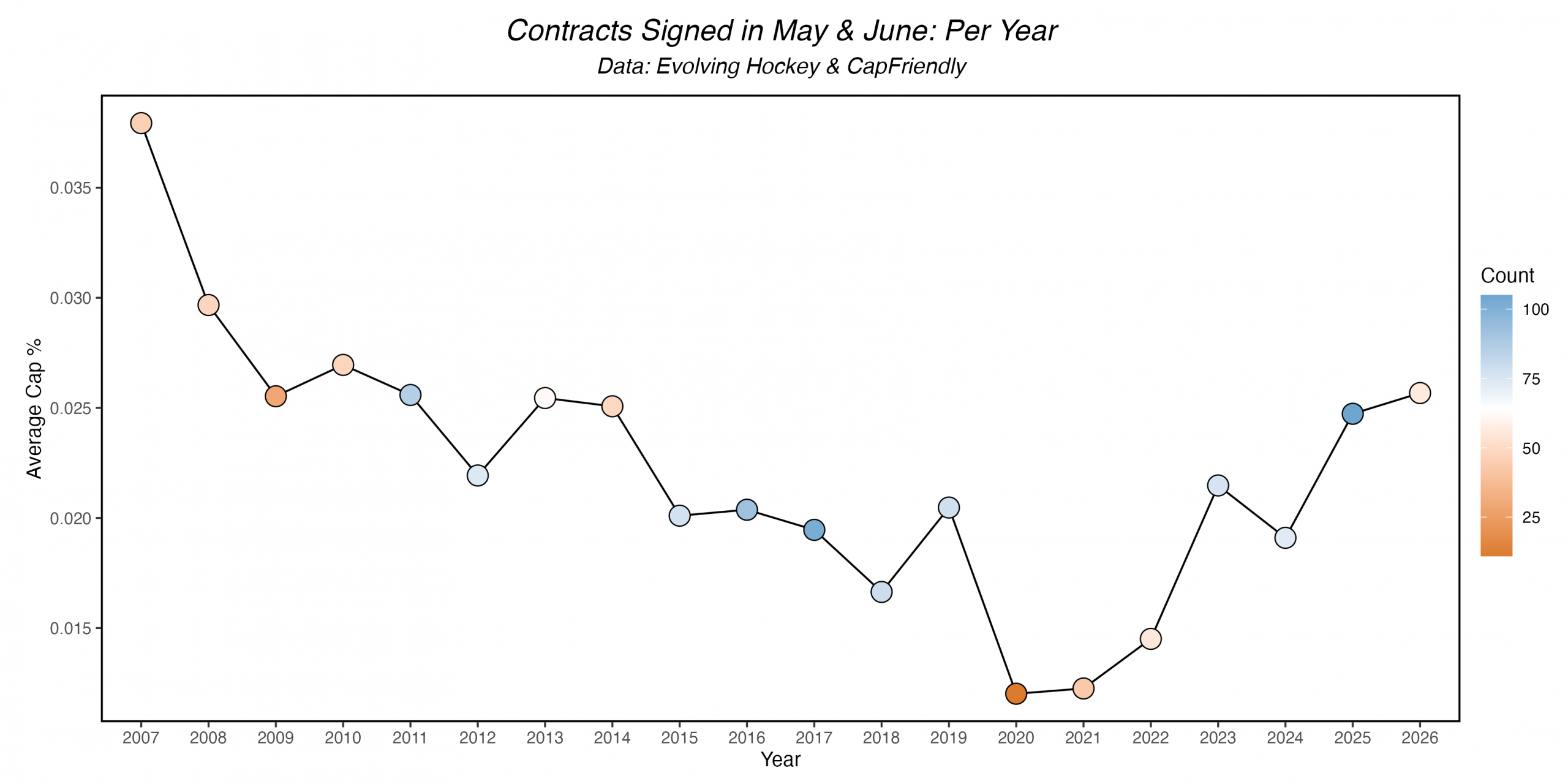
Last year we looked at this same chart, but I sort of messed it up (and then messed up the subsequent analysis of what the chart was showing). Instead of using raw cap hit like I did last year, I’ve switched over to using salary cap percentage (cap hit / salary cap) to account for the changing salary cap over time, and I’ve also removed ELC contracts for a better view of actual free agents. This gives us a much cleaner and more interesting view of what’s going on. While the average value of contracts signed during May & June is increasing, they’re mostly returning to the level we saw 10+ years ago. To be honest, the summer of 2007 is really throwing a wrench into the chart range here – anyone remember Timonen, Giguere, Markov, and Sundin signing contracts equivalent to $10M+ today during this time? I’m not entirely sure what happened that summer since I was graduating from High School and only slightly a fan of this sport – curious if anyone can let us know. Regardless, May & June have returned to what things used to be like over a decade ago, which is the reason things feel so anxious; it’s been a while since we’ve experienced what used to be normal.
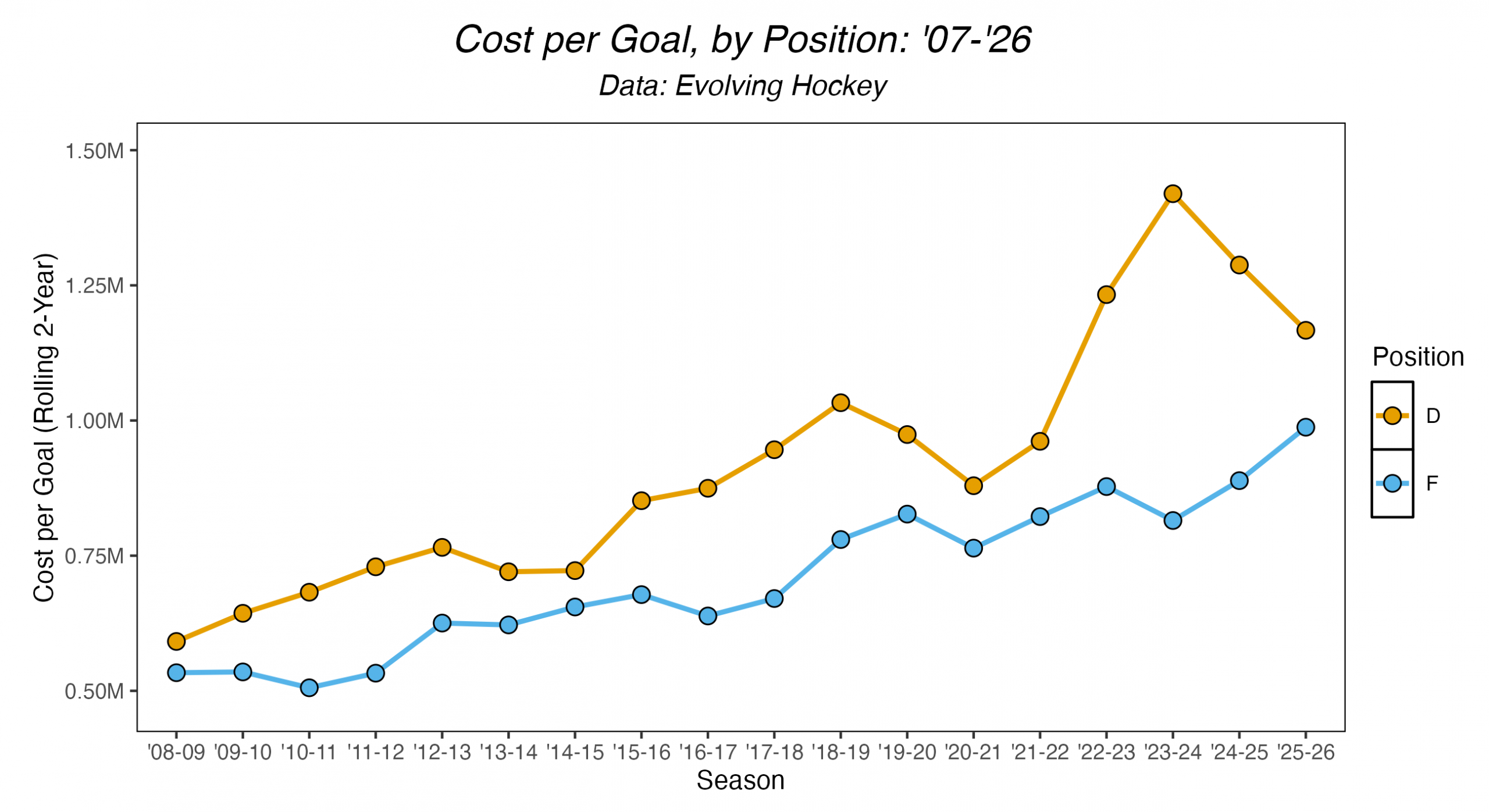
We’re also now seeing stabilization in the “cost” of a theoretical “goal”. Please reference our 2022 writeup for the full explanation of how this calculation works, but defensemen and forwards are now at a level that’s similar to those pre-pandemic. We’re not entirely sure what caused this extreme jump in goal value for defensemen but based on the calculation and the logic it indicates, GMs have now cooled a bit on hefty contracts for relatively weak defensemen that occurred during 2022 and 2023. Cost per Goal, by definition, should mirror the increasing salary cap to an extent, which is what we see here: forwards are now worth the same as defensemen used to be pre-2018. Again, CPG is not something that specifically correlates to actual contract expectations, but it’s a good gauge for how teams are valuing players and where those teams might gain the biggest edge (finding good cheap defensemen is still extremely valuable for any team, etc).
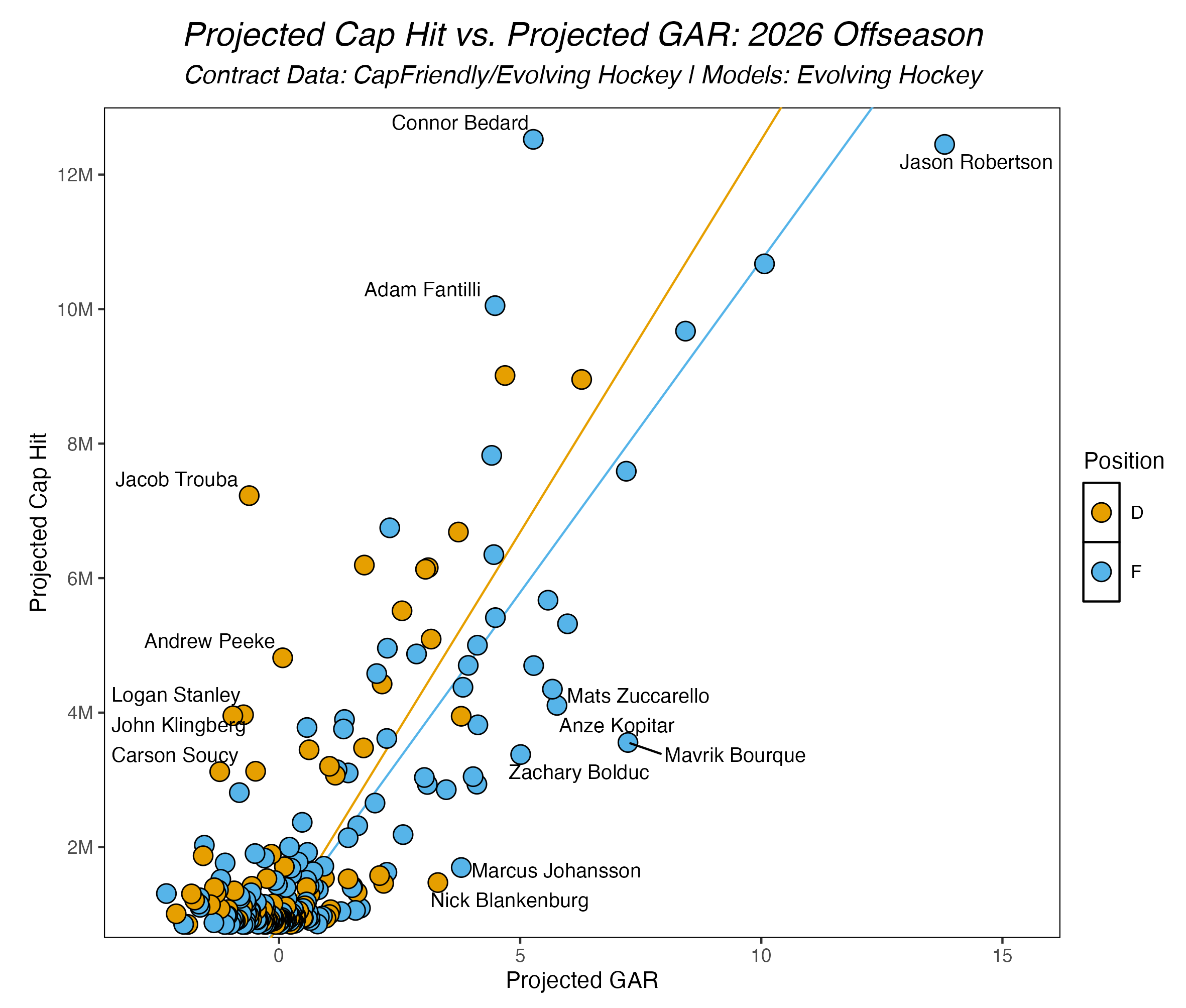
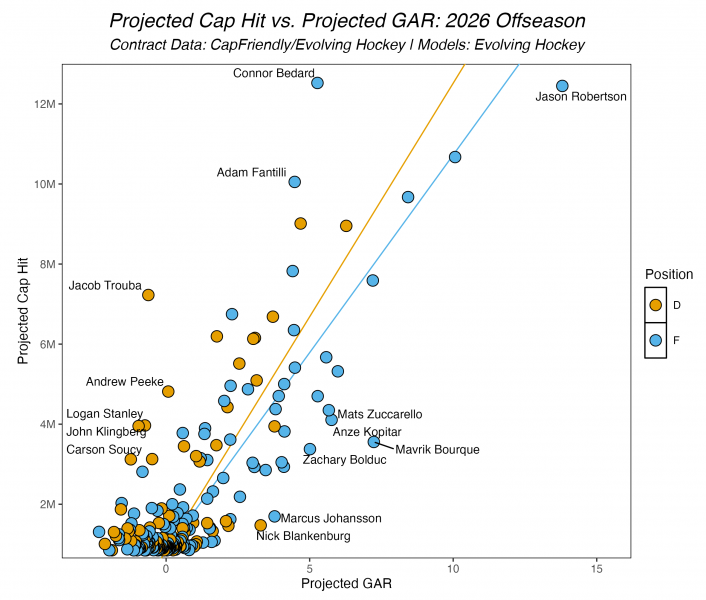
The return of the king! It’s been at least two years since I included this chart in our preview, and the reason for that is that I am stupid sometimes. Luke and I sort of big-brained some of the calculations for this and couldn’t figure out what we did wrong. This summer, however, we were able to fix it and get it running again. This is our peak of “theoretical visualization”: a final attempt to combine GAR and contract projections into one chart. This uses the same data as the tables below, but it provides an interesting high-level view of the current free agency market. The positional lines (orange and blue) show the x/y CPG values for each position (forwards were worth ~$988k, so every 1 GAR increase corresponds to this amount). It also shows us something that we all already knew: the market this summer is not good. The only free agent projected to make more than $6M per year with significant GAR value relative to our projections is Jason Robertson. Almost every free agent that we’ll cover below is a true depth or role player, which is what we see above (there’s a lot of white space on the right-side of this chart). This will truly be a summer of value.
Best Value: UFAs
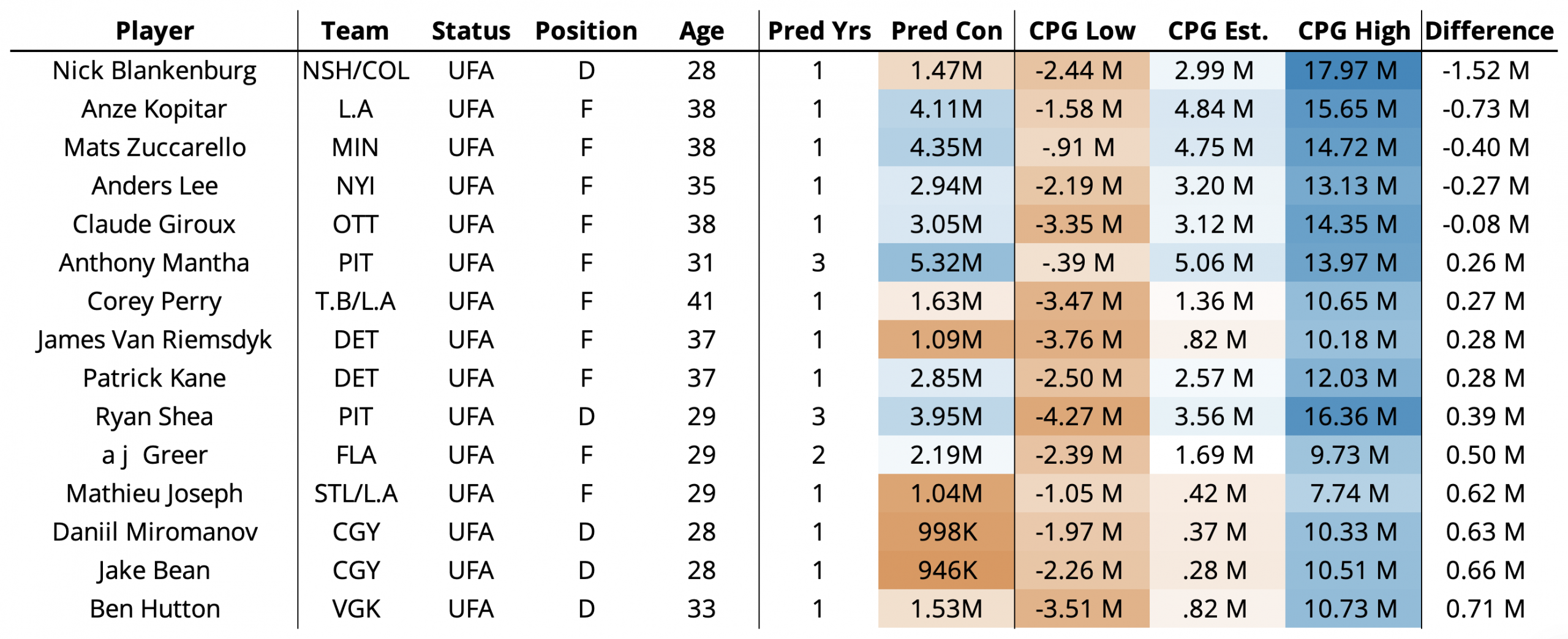
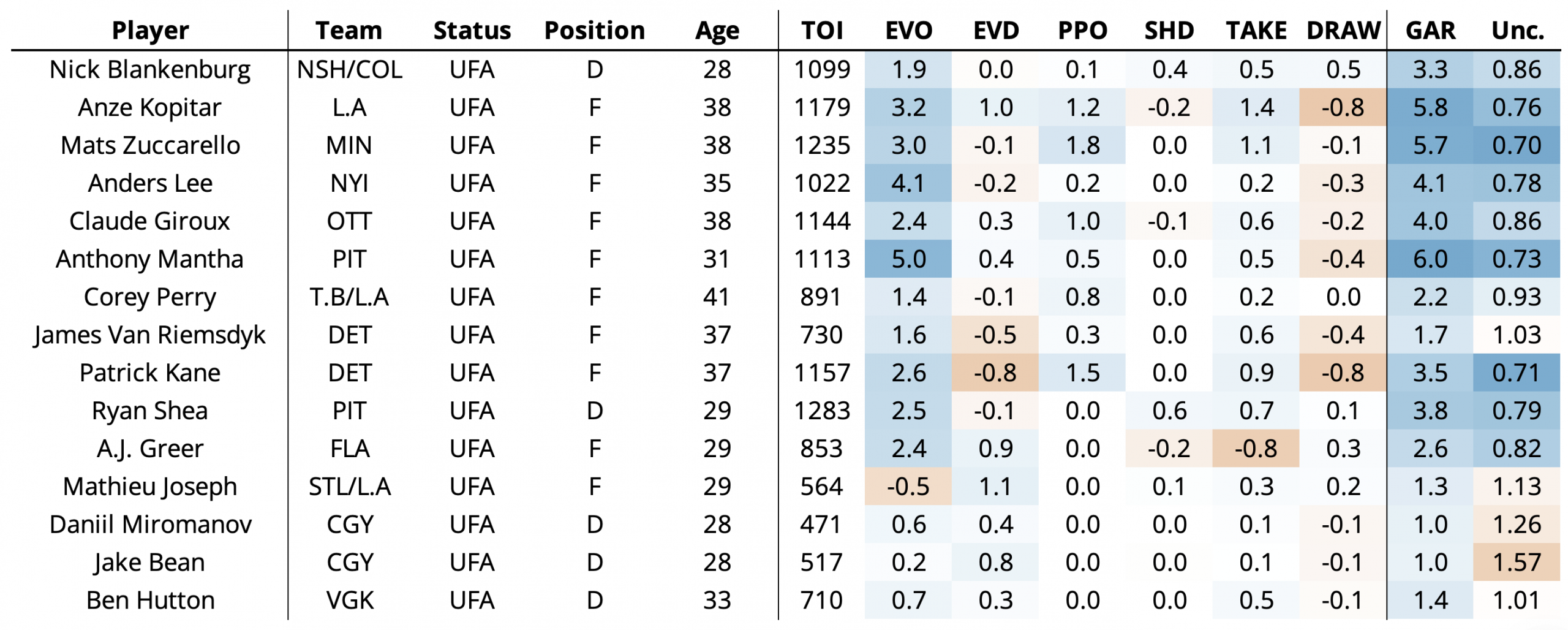
Last year I said 2025’s free agency class was the weakest we’d seen since doing this preview, and I was certain that 2026 would be even worse. After working through everything, getting all the charts set up, and analyzing it all I can say this: 2026 is the same as 2025 in a lot of different ways? Instead of Skinner, Gavrikov, and Kuzmenko leading the UFA-value-charge, we have Blankenburg, Lee, and Zuccarello. I left Kopitar in here for two reasons: he does a good job of representing the kind of valuable UFAs that are available, but also, I secretly kind of want him to un-retire and sign with the Wild. If I can’t have old Koivu, I want old Kopitar damn it.
2026 is the year where Evolving Hockey gets old. This is the oldest group of UFAs I’ve seen in this table since 2022, and almost half of them were stars 10+ years ago. I never thought old Patrick Kane would be heralded as a “value add” by our website, but here we are. I feel like there’s a Moneyball reference I could make right now, but we do that too much. Over the past few years we’ve seen more teams sign aging prior-stars to low-$ contracts in lesser roles and succeed, but we’ll likely see more of those aging stars signed this summer than any I can remember. Again, I would like Kopitar to be on the Wild please. Let’s talk about some players.
Mats Zuccarello
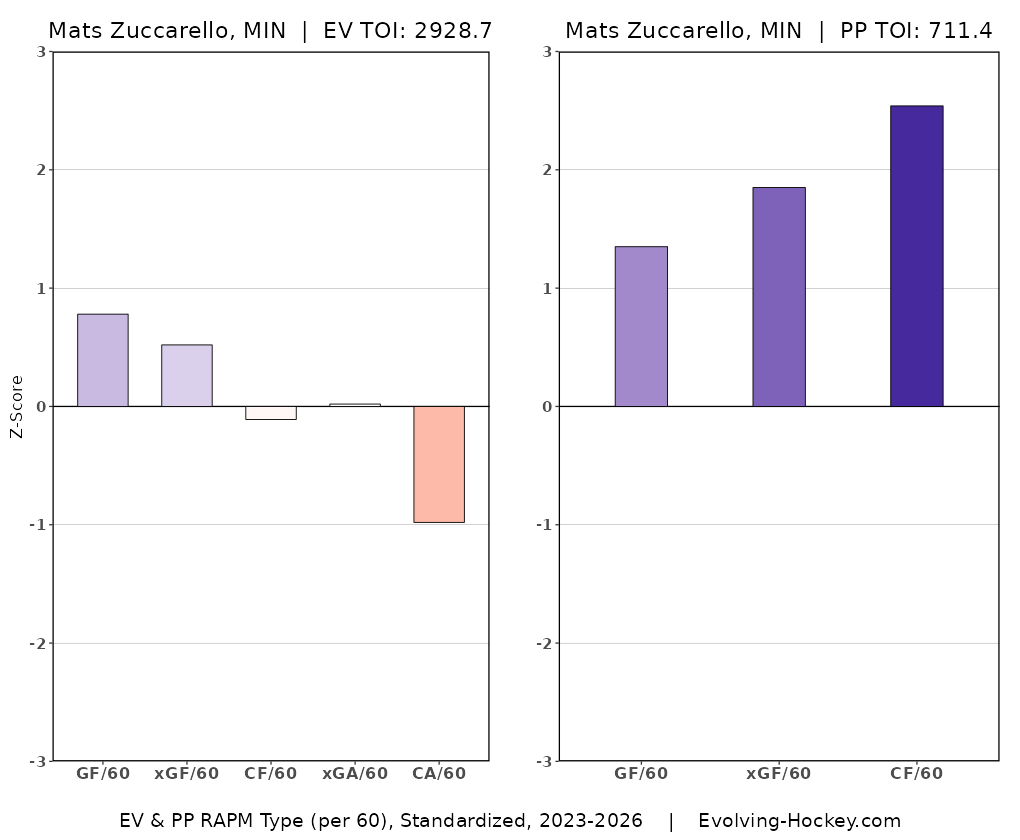
Zuccarello is a very interesting UFA. He will be 39 by the time next season starts, and the Wild do not appear interested in re-signing him (which is somewhat odd given how much his presence over the years has smoothed out their lineup – at even-strength and on the powerplay). Zuccarello is still a very serviceable forward at his age (especially on the powerplay) and that’s pretty rare. He ranks 8th in total xSPAR over the last 3 seasons among players who were 35 or older at the start of the ‘23-24 season, which is very impressive given how little he seems to be covered (at least from what I’ve seen). Given his age, our contract projection model projects him signing a 1-year deal with an AAV of $4.35M, and, at that contract, there are plenty of teams that could benefit from a player like Zuccarello. I expected a decent amount of interest in a veteran like him, and, to be honest, I’ll be sad to see him leave the Wild.
Nick Blankenburg
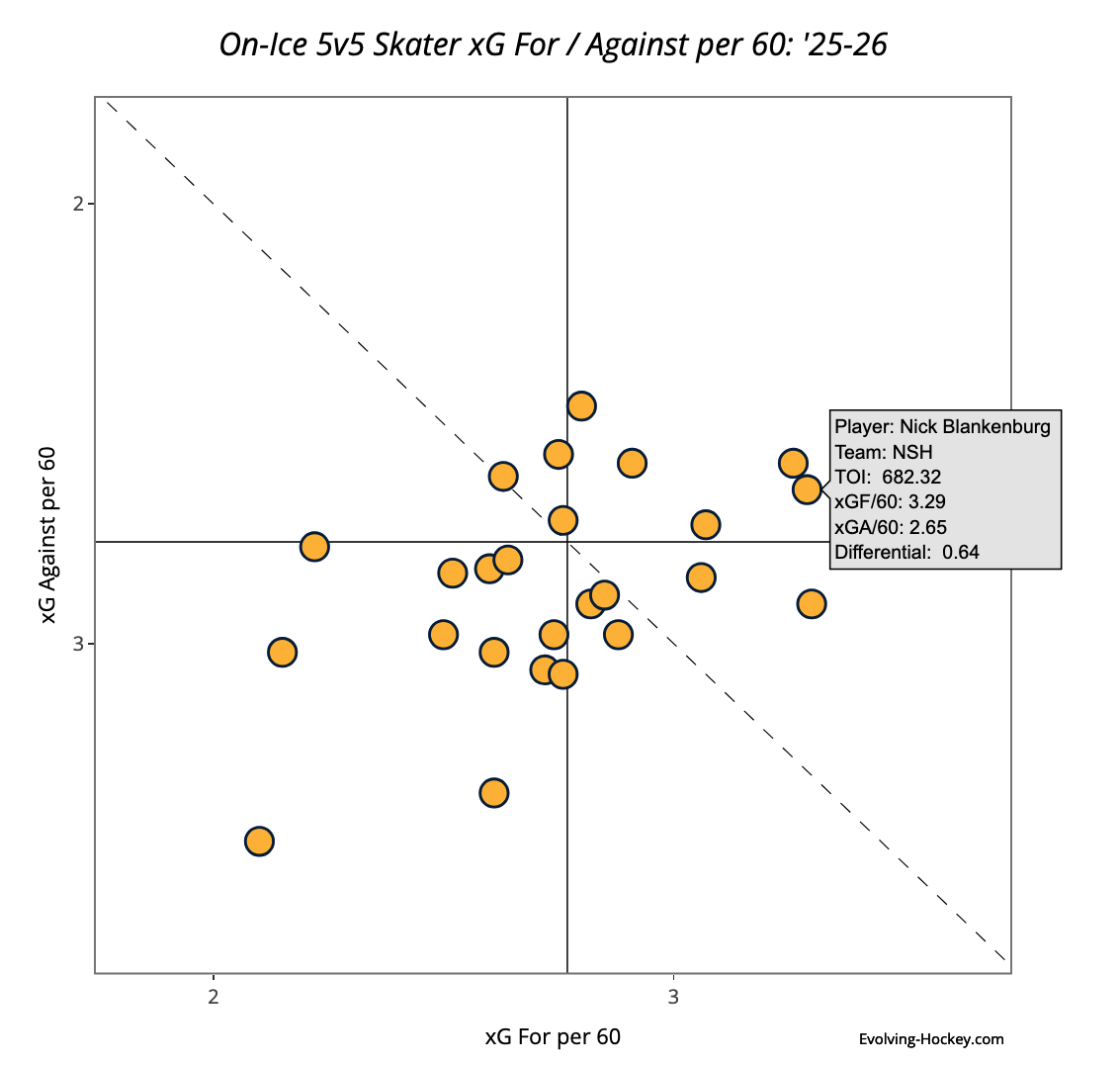
During his time with Nashville since the start of the ’24-25 season, Blankenburg posted over 14 xGAR in 109 games. Mostly utilized as a depth defenseman alongside Hague, Stastney, and Barron, he was quite effective in his role. It’s not necessarily surprising that Colorado traded for him at the deadline to fill a depth role for them heading into their (what should have been longer) playoff run. He only played 12 games in the regular season and 5 in the playoffs with the Avalanche, but he continued to produce reasonably from an on-ice perspective. Blankenburg is a great example of what this summer’s free agency class looks like. You’re not finding marquee players here; you’re improving those weak-links and bolstering positions that are lacking. There are some things to consider here: he played less than 60 games with the Blue Jackets from 2021-2024, and the results weren’t necessarily noteworthy. That said, it wouldn’t surprise me if a smart team picks him up on our projected modest deal to fill a third-pair role.
Anders Lee
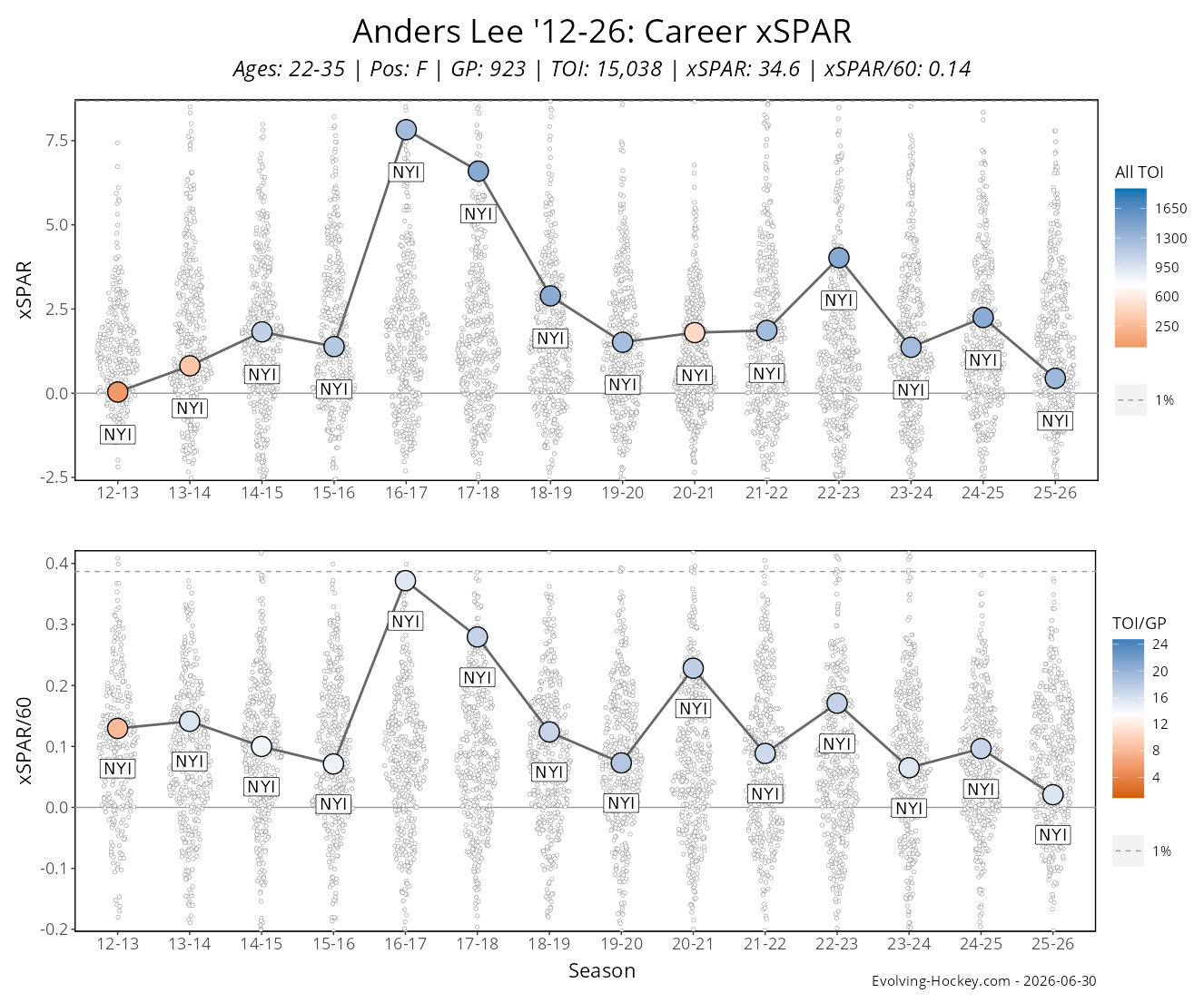
That good ‘ol Edina boy. Anders Lee is old (but he’s younger than I am so he has that going for him). I started here by writing a paragraph about Marcus Johansson because I somehow completely missed that he signed in Sweden a few weeks ago, but Anders Lee sort of oddly fits in that same category. At 35, Lee is well-past his double-digit xGAR glory days from 10 years ago, but he’s still been quite serviceable with the Islanders. Oddly, it would not surprise me if the Wild potentially consider Lee given his hometown roots and oddly similar profile to Johansson (at least from a numbers perspective). I’m not apologizing for the Wild discussion. With a 1-year contract projected below $3M, Lee ranks as one of the best value UFAs this summer. Like a lot of players in our list, it would feel weird if they don’t return to their prior team.
Best Value: RFAs
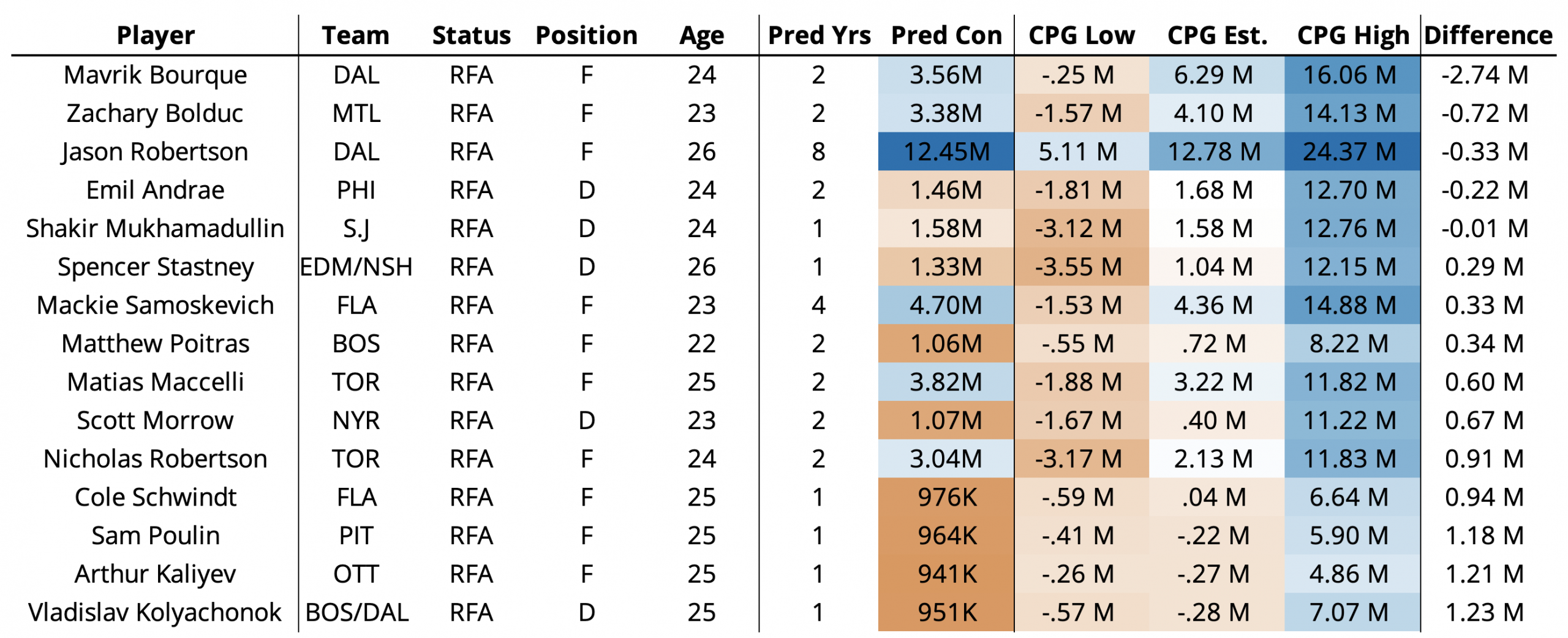
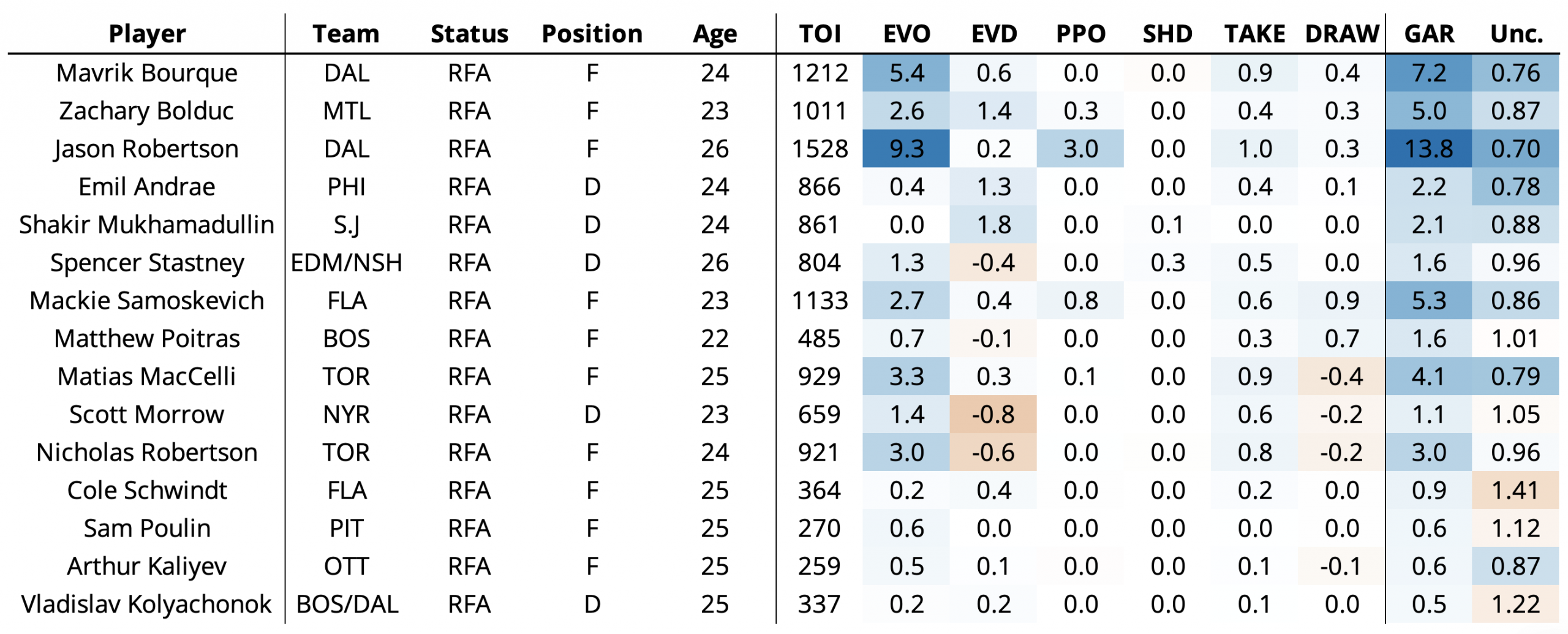
The RFAs this summer are a very strange group for a lot of potentially concerning reasons. Where are the actual RFAs we’ve been hearing about? Where the highlighted group of value-UFAs above contained almost entirely 32+ year old players, our table of RFAs contains one great young player: Jason Robertson. The Bedard, Fantilli, McMichael, Gauthier, etc. group isn’t represented at all. Honestly, this surprised me. From everything I can tell, the rising salary cap plus an odd trend of these young players putting up box-score numbers that aren’t necessarily backed by accompanying on-ice numbers seems to be pushing their “value” in free agency lower than what we’re used to. There’s also the concerning fact that quite a few of the remaining high-end RFAs have, so far, shown no ability to defend whatsoever. Yes, I get that they’re still quite young, and many of these players skate for very bad teams, but a lot of prior young RFAs found themselves in very similar situations and weren’t quite this bad. Things are (probably) going to get a little weird this summer with a few of these remaining players. Whether it’s extended hold-outs or a few more trades than we’re used to, I have a feeling something is going to happen. Or nothing could happen. It is NHL free agency, after all.
Jason Robertson
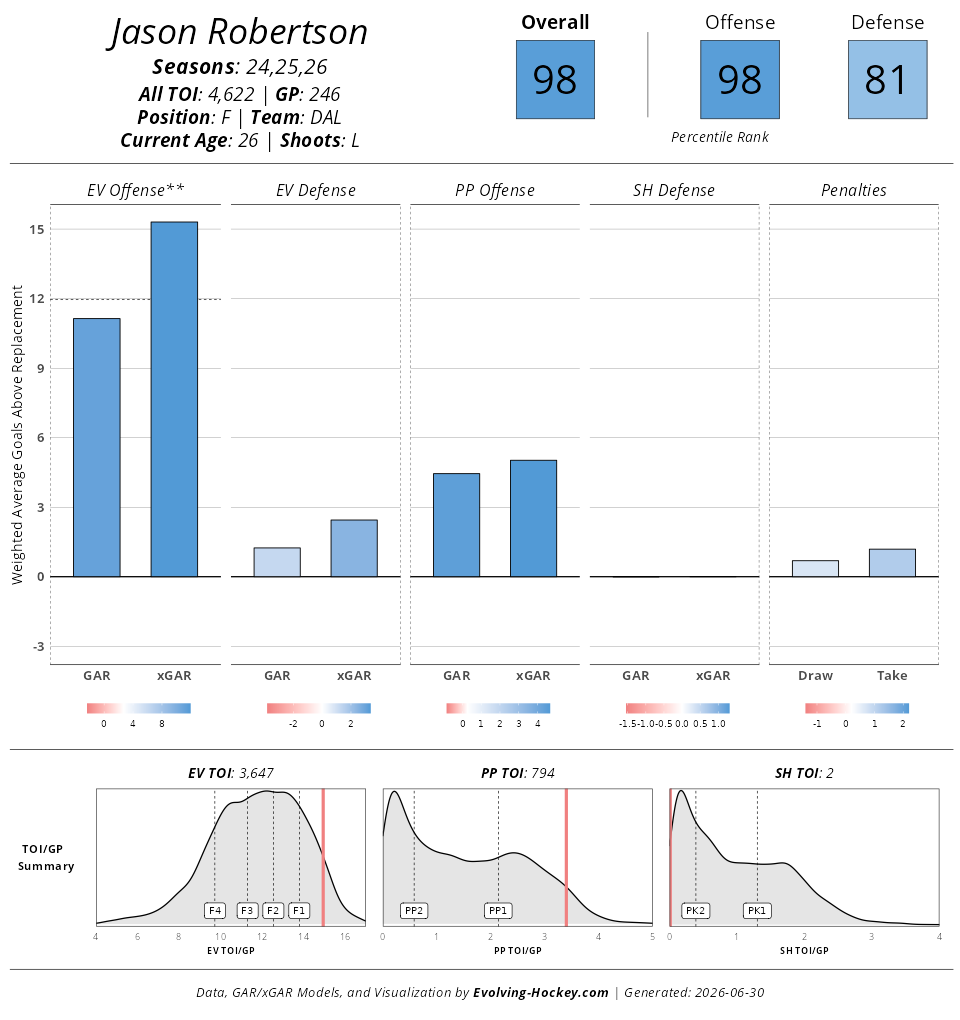
Jason Robertson. The best forward in the NHL that didn’t make a 2026 Winter Olympics team (I’m still a little mad the US won gold because they did it without Jason Robertson and I wanted to be vindicated when they lost because they didn’t bring Robertson). I mean, there’s not much else to say here. Robertson is by far the most interesting story this summer: Seattle tried to pay him $15 million for 8 years and he said no, Dallas is having trouble signing him to any amount, and it’s probably for good reason. He (or his agent) knows he’s easily the best available player this summer. Is he worth it? Yes. Is $15M an overpay? I mean, probably (our projection has him signing with the Stars for 8 years ~$12.45M). Regardless, if you’re going to overpay a player, Robertson is the one you do it for. Our just-released GAR Projections for the ‘26-27 season rank Robertson as the 4th best forward in the NHL (3 spots higher than Kaprizov who signed for $17M per year)… So, yeah, I think he is worth $3 million more than what we projected. Personally, I kind of love the idea of him in a Senators uniform, so I’m pulling for that. He’ll probably just be boring and stay in Dallas though.
Matias Maccelli
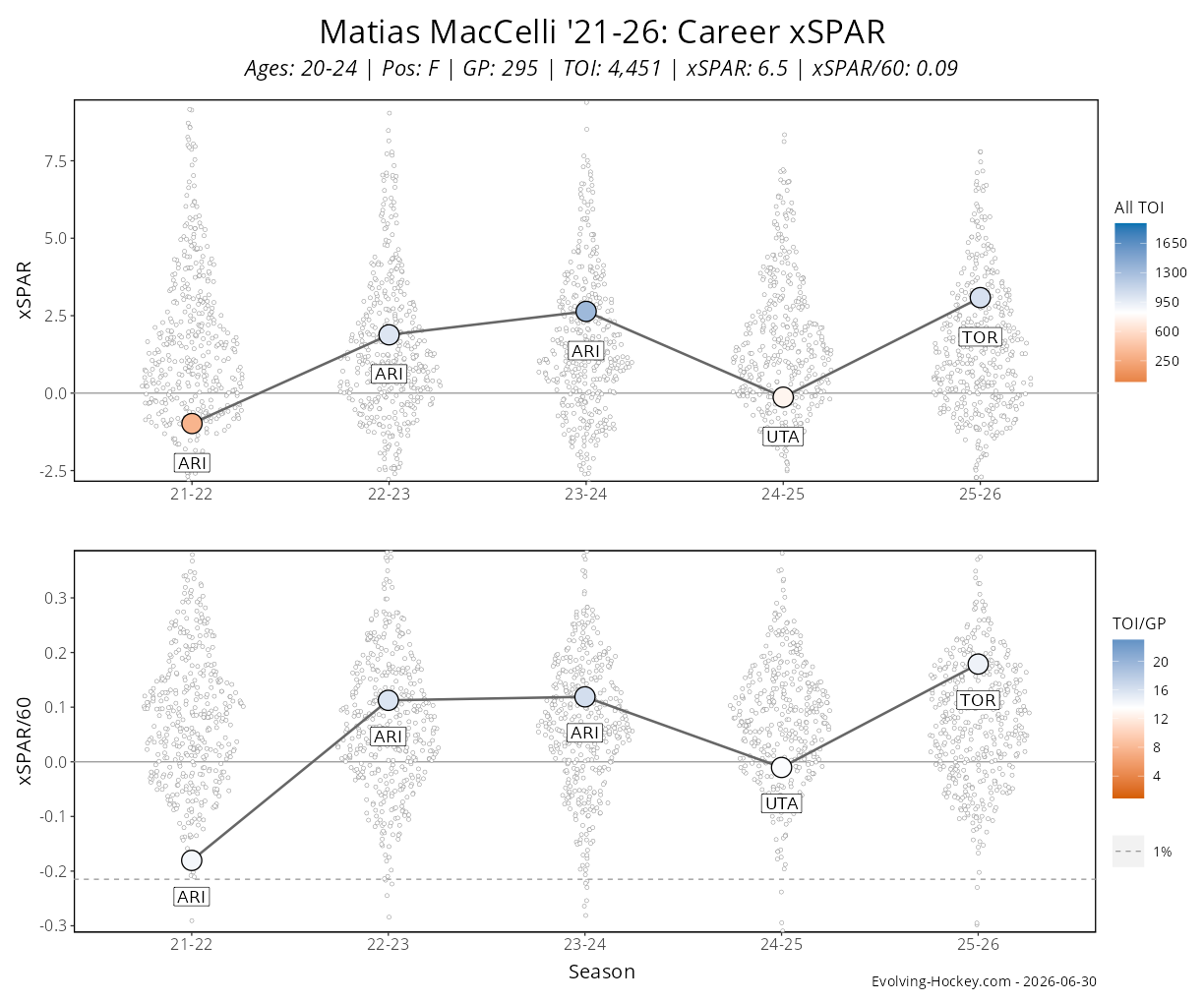
Well, the Leafs didn’t qualify Maccelli. I’m not really sure why, but he is now a UFA (they could’ve done this like a week ago and then we could’ve changed this). Regardless, he’s an RFA for the time being. Per our xGAR model he had the best NHL season of his career with the Leafs in ‘25-26 (3.1 xSPAR). Maccelli is a promising young-ish player that most NHL teams tend to extend (he had a rough ‘24-25 season in Utah, but he was very good in Arizona the prior two seasons). At 2 years x $3.82M, I’m a little confused why the Leafs didn’t make that deal. Maybe he wants a longer contract, the Toronto pressure is too much, or maybe he just doesn’t like Toronto?? Much to think about. Regardless, I think a smart team could really benefit from signing Maccelli to fill a depth role. The potential is absolutely there, just like there’s a ton of potential for us to finally fix the way his name is formatted on our site. But like a lot of things, sometimes we don’t live up to that potential. The way of the world.
Zachary Bolduc
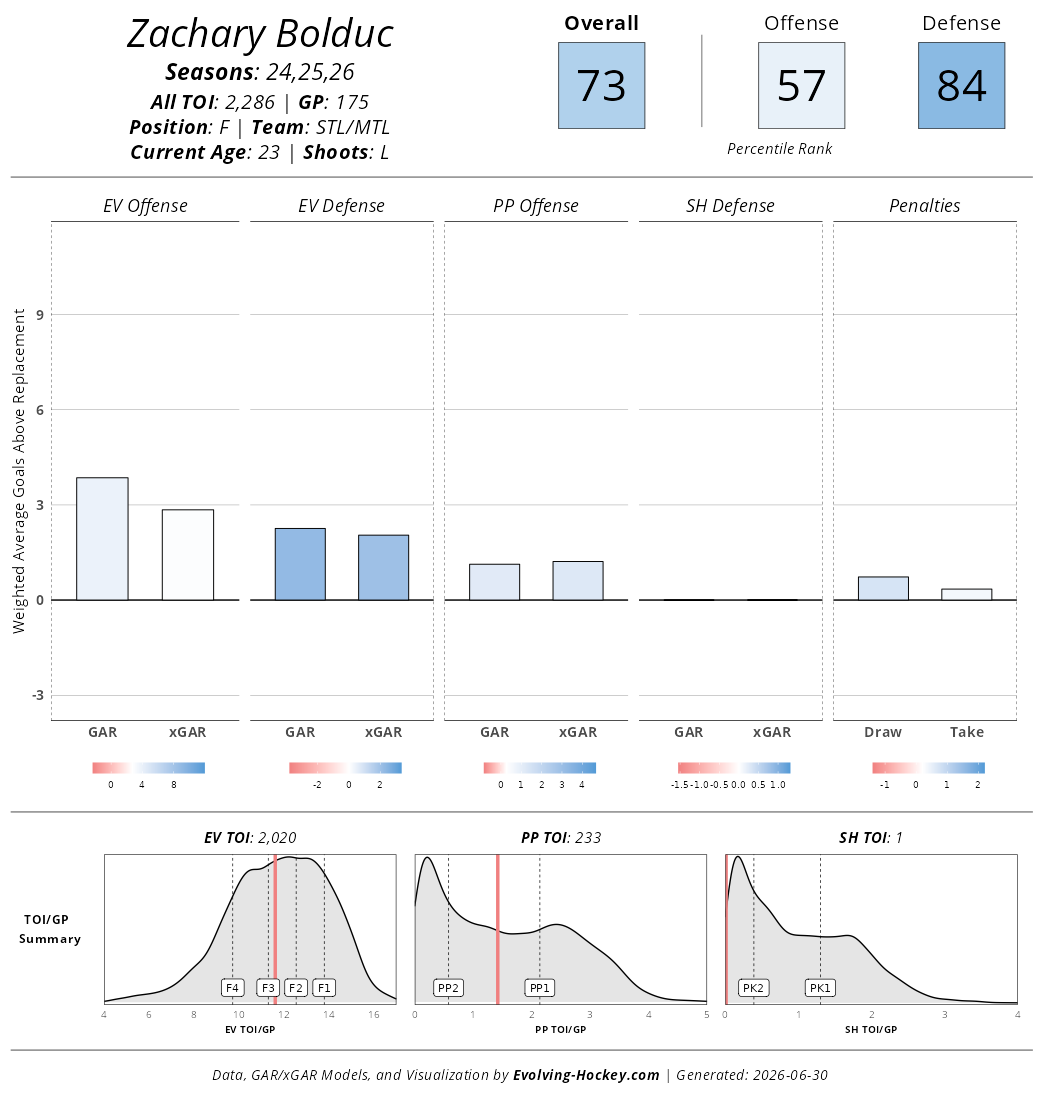
Bolduc. One of our guys. As a previous Evolving Hockey Calder finalist (i.e. like top-5 two years ago per our Calder ranking), it was hard to understand why St. Louis traded him last summer, just like it’s hard to think Montreal won’t get a deal done here. He took a step back during his “sophomore” season with the Canadiens, but there’s still a ton of upside here for the 23-year-old. That said, given the lackluster free agency market and energetic RFA trade market, Bolduc seems like a perfect candidate for either a trade or a potential offer sheet. With the model projecting a quite reasonable bridge deal at 2 x $3.4M, Bolduc represents one of several potential targets for teams looking to get feisty. While it seems unlikely, one can never really know what certain GMs have cooking, and for a player whose great defensive results at such a young age indicate a bright future, Bolduc is our pick for the most likely RFA to move heading into July 1st.
Worst Value: UFAs
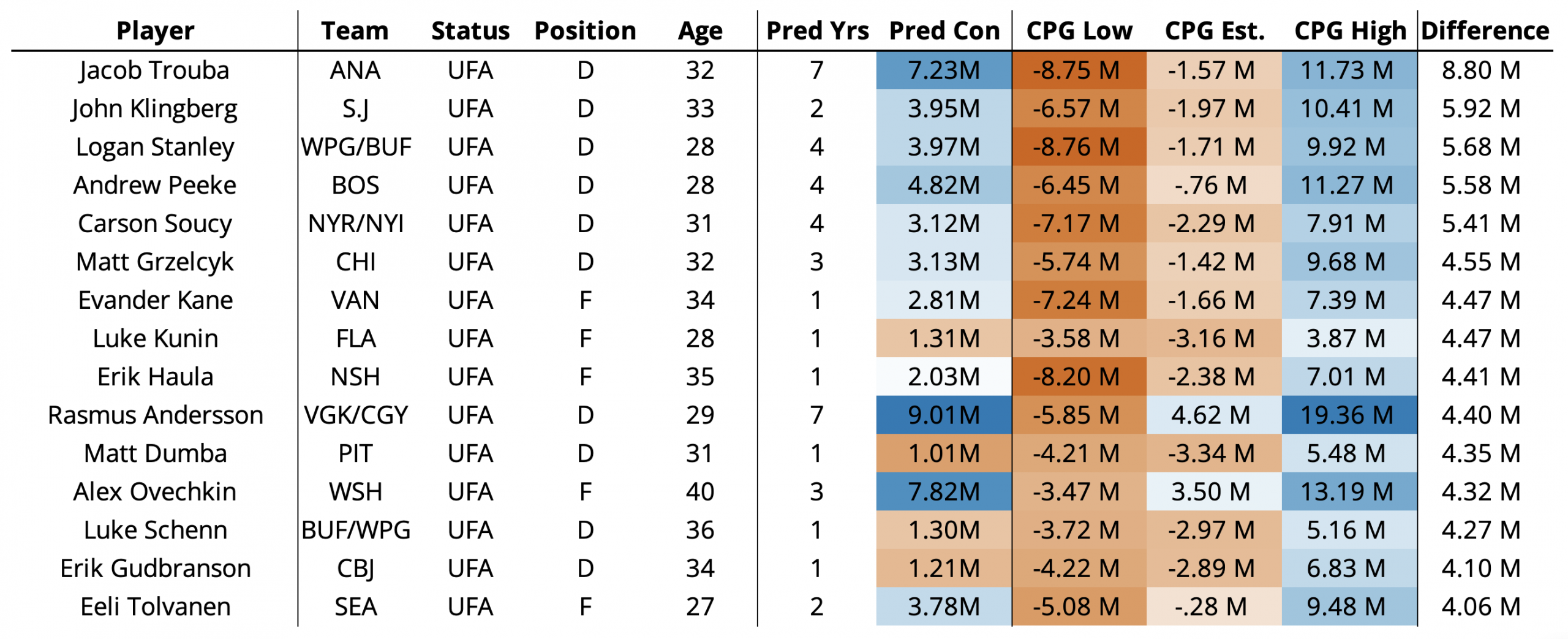
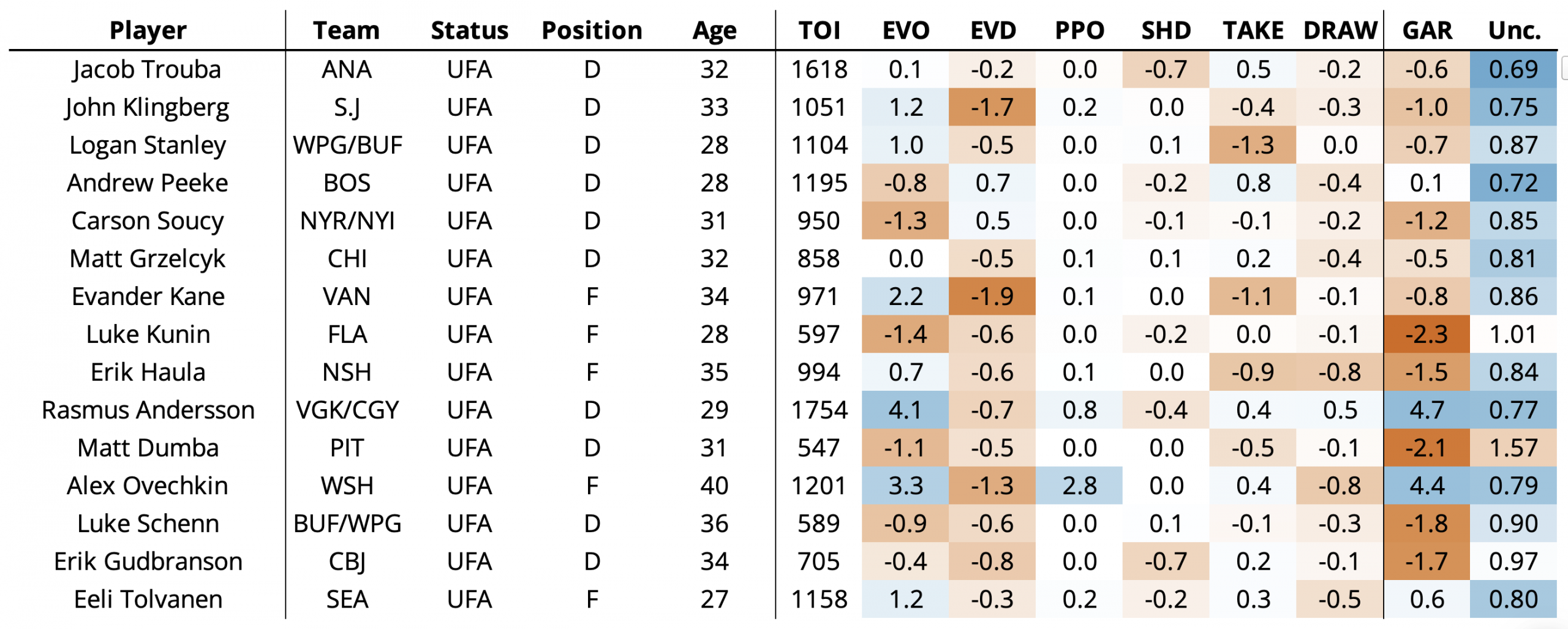
And as always, we must provide you with a list of players that we think your favorite team should try to avoid signing at all costs (assuming their projected contract is the signing amount). Look, as we’ve gotten older, Luke and I have realized that you don’t always have to hate, so we try to save it for when it matters. This is the time. I can’t get enough of bad players signing really bad contracts in July. I’ve watched players like those listed above sign huge contracts ever since I first started watching hockey, and if this consistency become inconsistent, I feel like I won’t know what to do. It’s like going out to prune that bush in your front yard every year that you haven’t yet realized is Common Buckthorn and you never really stopped to ask yourself why you’re still doing that and what that bush even is in the first place. You don’t need to prune Buckthorn. You should actually really kill that shrub because it is invasive in North America… Hold on, this went a little off the rails, but you get what I’m saying here. This is a good analogy, and I’m sticking with it. Jacob Trouba is Common Buckthorn.
Free Agency starts tomorrow! The summer of 2026 is fully underway. Is this free agent class good? No. Is your team going to get significantly better by signing a few UFAs this summer? Probably not. They might get a little better though. Your team could, however, get a lot better by offer sheeting a certain RFA or two. We’ll be following along with all of you as the offseason truly unfolds. As is now tradition, we’ll be back with another full analysis piece in August covering how our contract projection model did and recapping the free agent market. In the meantime, I hope your favorite team adds the best players and you guys win it all in 2027.