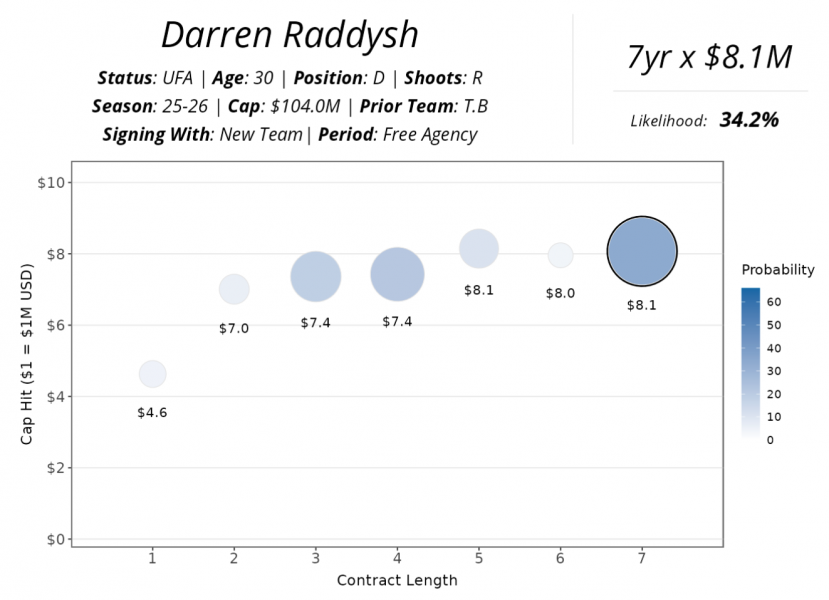
Our annual contract projections for the NHL offseason are now updated and available on the site for Pro subscribers! As many of you know, we’ve been doing these for a while; our first version was completed and “published” back in 2017. Since then, we’ve made quite a few improvements to the models, and the current system we use has remained more or the less the same for ~5 years. Like I mentioned last year, the main page for our projections defaults to all free agents based on our data, but we also provide projections for extension-eligible players (those entering the ’26-27 season on the last year of their current contract), and projections for players who fit neither of these categories (players with two or more years left). These can be accessed through the “Free Agent” dropdown. The projection system we use is comprised of four total models: skater term, skater cap %, goalie term, and goalie cap %. Over the past few weeks, I’ve done quite a bit of work, as I do every year, to improve each model in the process of retraining everything with the new contract data we’ve collected since last year’s projections were released.
For the most part, this left us with a very similar model to those in recent years (aside from the new contracts signed since last May now included in training), but a few adjustments were necessary:
- Goalie age tier adjustments (skewed slightly higher)
- New model parameters for the skater cap % model (not major)
- Small adjustments for players signing their first contract after an ELC
If you’d like to read more about the entire modeling process or the “high level” explanation in our Glossary, check these out:
Like I mentioned last year, we’ve been tracking contracts ourselves since CapFriendly went dark in July, 2024. Over the last few weeks, I’ve audited our prior tracking to ensure we didn’t miss anything or overlook an updated/revised value from what was originally reported. While we got our start in brute-force data work because we didn’t know you could do it any other way (some of you may remember our original Marcel model accounting for survivorship bias done in Excel that wouldn’t work on my old computer because it was too big), it’s possible a mistake may exist in the data. If you see anything that looks funny (a player listed as a free agent who isn’t, someone noted as extension eligible that already signed, an incorrect UFA/RFA classification), please let us know. But in reality, everything is perfect and correct and we’ve never been wrong (please let me know if we’re wrong).
With some of the modeling information out of the way, we can move on to the good stuff: the current contract environment. Things are getting weird. As we’ve noted over the last two years, the NHL’s salary cap is increasing. With confirmation just a week ago, we’re now entering the first summer where the salary cap will break $100M. Since the ’23-24 season, the salary cap has increased $20.5M, and this season’s $8.5M jump is the largest that’s occurred since the salary cap was introduced in 2005. Our current projection system uses salary percentage as our target variable (cap hit / current salary cap), which better accounts for salaries across eras. While the contract model has done quite well during these shaky times, we’re entering possibly the most volatile offseason any of us have ever experienced. I’m not sure even the COVID offseason was as wild. While last summer’s model performed relatively well, we’ve had quite a few interesting extensions occur recently (Kaprizov, McDavid, Huston), which continues a trend we’ve seen since at least 2022 of more non-ELC contracts signed during the non-offseason (re: season). Since 2022, the average number of extension or non-ELC contracts signed during this period (September to May) has jumped by about ~25 relative to the 2010s.
Which brings us to the biggest uncertainty heading into the 2026 offseason: max term limits and the increase in the league minimum salary (now $850k). The NHLPA ratified a new CBA in July, 2025. Per the NHLPA, this will take effect on September 16, 2026. With the new CBA going into effect, the max term for any given contract will be shortened to 7 years for players signing with their prior team and 6 years for all other free agents (down from 8 and 7 years respectively). This is a big change for a modeling system that only has data in the 1–8-year format (remember, we had previously capped the small number of >8 year deals to 8 years for training purposes). Our projections have actually been finished for a few days now, but during that time we came across conflicting information re: when the new CBA will take effect. We’ve checked with a few sources and verified that the prior 7/8 year deals will be available this summer even though several sites have indicated that the new CBA rules may go into effect sooner. While the new CBA won’t impact the current projections given we won’t have to somehow “adjust” for the new term limits right now, it may very well impact the contracts that players sign ahead of these changes. Will a team go up to a 7- or 8-year deal for a player who historically wouldn’t warrant that extra year because this is their last opportunity to do so? Are we going to see more players signing league minimum deals or less? Is this free agency class even worth the largest salary cap increase we’ve ever seen? Maybe not, but players entering the last year of their deal might warrant it.
For the first time in seven years, we’re projecting less than 350 contract for existing free agents. Teams (and players) appear to have hedged against the looming uncertainty of the salary cap over the last 2-3 years and either locked-in players before their value potentially rises -OR- players may have taken a solid offer because they didn’t want to test an uncertain market. Either way, we’ve seen more players extend than we’ve ever seen, which leaves the free agent market somewhat lacking in high-end talent. That doesn’t mean value has disappeared, it just means you’re all going to have to try harder. Luckily very few of us own a team, so we all get to sit here and analyze the signings that take place and experience the full spectrum of emotions.
While some of the above might sound like we’re concerned, we’re actually more interested than anything; our models performed either equally well or better compared to prior years during training, and we found no indication to give us pause heading into the summer. For the first ~5 years of us doing this, little changed in the contract environment. The salary cap rose incrementally, teams signed overvalued UFAs, bad defensemen, and some really good players along the way, and our model got the fuel it needed to continue projecting these scenarios. Now we’re entering a summer where things might change. Or they might not – I hope they don’t, I don’t like change. Our contract projections for the 2026 offseason are live, and we’re entirely ready to follow along. Just like all of you lovely people, we’ll be here, and we’ll be running some scripts at the end of July to see how we did. As my mother always said: safety + fun.
With love,
– Josh & Luke