The ’25-26 NHL regular season was absurd. The Buffalo Sabres made the playoffs for the first time in 4 decades, the Kings didn’t win a game in regulation, the Leafs missed the playoffs with a team everyone thought would be a contender (a quick joke in the intro), and there seems to be only one favorite in the entire league. The only thing that wasn’t absurd? Our preseason point projections performed perfectly because we’ve never been wrong. I’m going to warn you: this got long. I’ll only be a little mad if you skim this for the charts and numbers and skip everything else. You’re all familiar with the storylines and the drama and the Pacific division. You don’t need me to elaborate on these things in the intro (see: all the words below). But the words are there. We do this for you, dear readers, and we expect you to enjoy it.
A note: it took us (a rag tag group of three people) a lot of work to get our model finished and the writeups done before the playoffs started – if you remember, we were a day late last year, and I’ll never forgive myself. We’ve done the best we can, with limited “insider information” and time (stressed), to set the rosters for skaters and select the starting goalies to the best of our ability. At the time of publication, it’s still not fully clear which goalie several teams are going to start or whether a few skaters will miss time. We’ve tried our best to note these instances below, but if we haven’t, please adjust these inclusions/absences accordingly – we know you ‘re all smart, we trust you. It’s time to have fun during the best playoffs in the world of sports: the NHL’s first round.
The Model
Our playoff probabilities are generated in a three-step process. We use multiple models to project “future” values for all players, use these player projections to build a game probability model that projects the winning % of any given team matchup (logistic regression), and then feed these individual game probabilities into a Monte Carlo simulation that generates the probabilities for each series. In order to complete this process, each team’s player projections are aggregated into F/D/G groups, and various metrics are used for each group which are then fed into the game probability model. With these inputs, we are able to generate home and away team winning percentage values. Once we have projected all home/away probabilities for the playoff games, we prepare the simulation.
For the simulation, in a given game, we only care about the projected winning % for the home team. Take DAL/MIN. The process laid out above gives us a winning % for each team. In game 1, DAL is the home team. We replace MIN’s projected probability with a random % between 0 and 1 since they are the away team. If DAL’s projected winning % is higher than the random number, DAL “wins” that game (they “lose” if it is lower). In game 3 when MIN is the home team, we do the same for DAL (we replace their winning % with a randomly generated %). This is done for each team game in all series and then repeated 50,000 times. Once the simulation is complete, we check how many times each team won a game, sum the total games won in a series, and arrive at each team’s projected probability.
The first step is generating multiple player-level models which produce ratings for all players in the league. For skaters, we found our xSPAR metric (Expected Standing Points Above Replacement) as well as a custom “game score” model (built using Box Score metrics) worked best for predicting future team game outcomes. Our SPAR and RAPM metrics were also tested but they did not perform quite as well for this specific task. The “game score” model we are using is similar to Dom Luszczyszyn’s Game Score model; however, we tested various box score metrics and weighted them through a “grid search” approach to optimize predicting future team game win probability.
Eastern Conference
Buffalo Sabres (A1) vs. Boston Bruins (WC1)
63.7% 36.3%
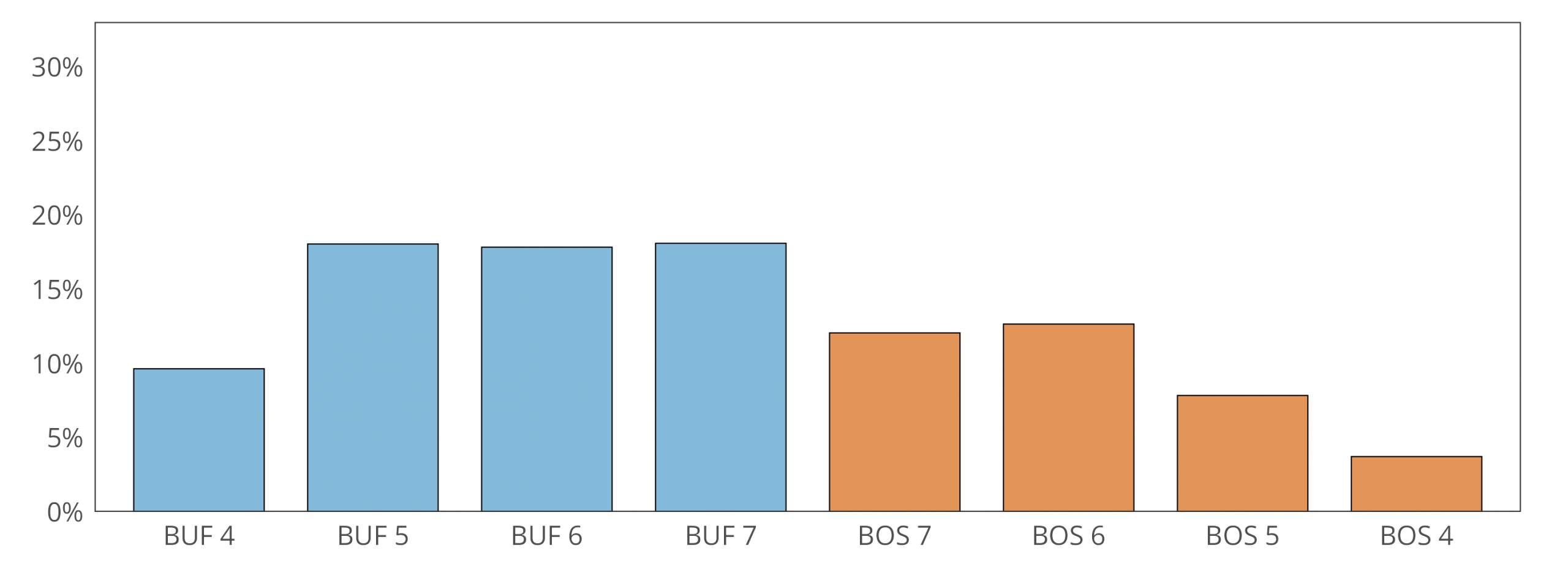
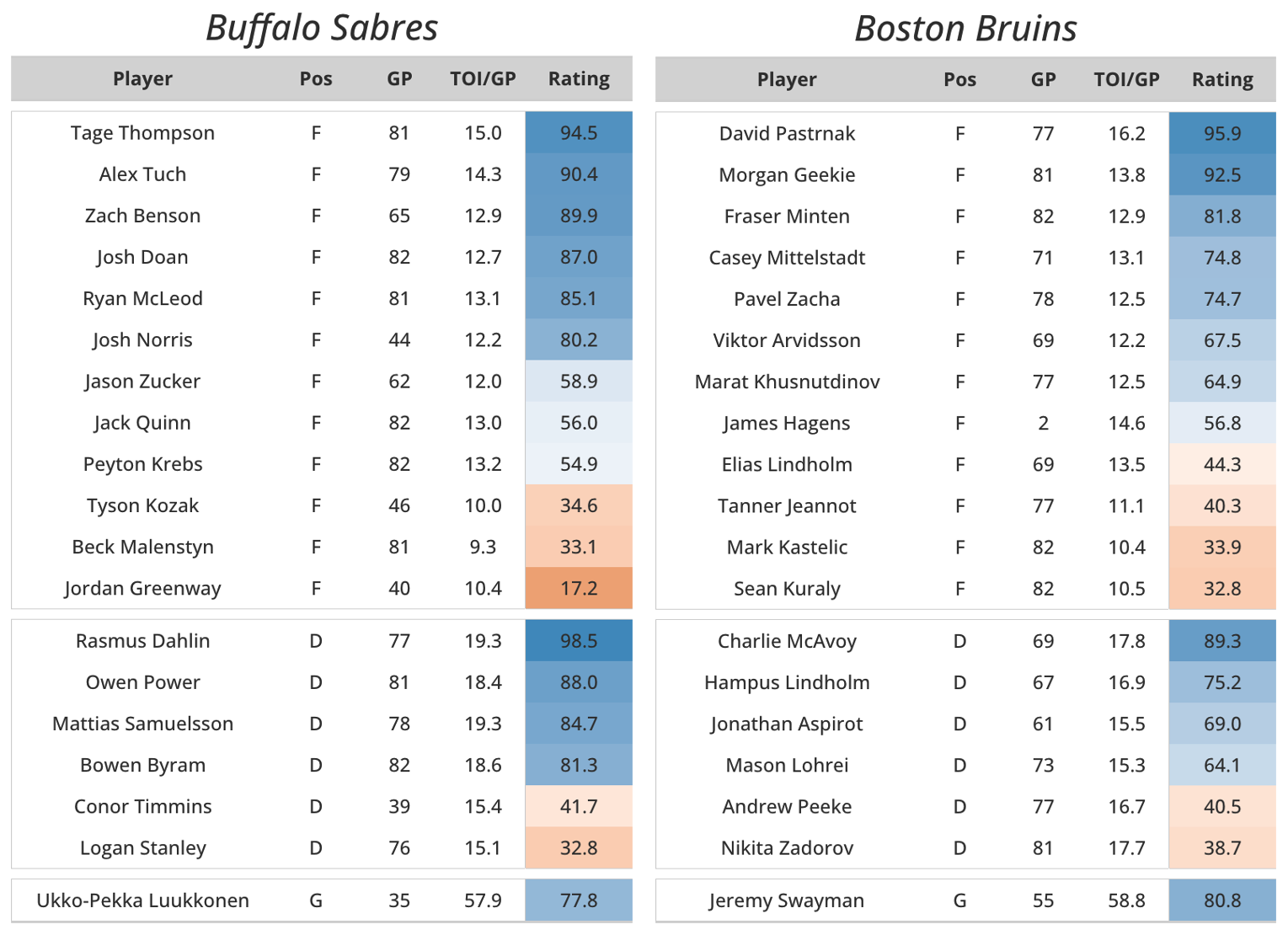
The coastal town of Buffalo is finally hosting playoff (hockey) games again. The Sabres admin went through the receipts on Twitter the other day, but we aren’t going to do that here (even if we would’ve welcomed it). As mentioned in our season preview, the Sabres entered this season with a ton of uncertainty. They had a young team with only two players in their thirties, generally welcomed by the model, but not always the general public. They also had some new additions after the Peterka trade. And what was going to happen in net (not big, stable names here) was not known at all. Throughout the season, the Sabres offered clarity. While only Dahlin is being discussed for an award this summer, the entire team decided to will an above-expectations season after years of never doing that. The only regular for Buffalo this season with a negative GAR was Jack Quinn (I guess our scouting report, sigh, was wrong). Josh Doan was spectacular this year after we saw glimpses of potential in his 62 prior NHL games: 26 goals, 26 assists, roughly four standings points above replacement, and a contract extension. Possibly most importantly, the team had goaltending! Alex Lyon and Ukko-Pekka Luukkonen split the net for most of the season, each contributing roughly equal weight (10.5 SPAR). Of course, the pressure here is immense (or at least one has to assume) entering the playoffs for the first time since 2011. That is going to be challenging for a young team with many playing in their first playoff game. That’s the reason the Sabres acquired Luke Schenn at the deadline, right?? Buffalo had very little to lose when they were on the cusp of a playoff position a few months ago, but will it add up entering the playoffs as the Atlantic leaders? No. Not at all.
What are the Boston Bruins? How did they end up here? No one really knows. Our preseason projections had them last in the Atlantic with 82 points, yet here we are. And looking at the roster, one that changed very little with a quiet deadline, you can see why. Yes, they have David Pastrnak and Charlie McAvoy, two of the best players in the game who contribute a significant amount to the Bruins when they are on the ice. But after that, the falloff begins. Morgan Geekie backed up his 33-goal 20%+ shooting percentage season last year with 39 goals this season. This helped him lead the team in xGAR, and forces us to ask whether this is normal. Pavel Zacha scored 30 goals this season with a 23% shooting percentage, and Viktor Arvidsson had quite a bounce back season after struggling the last couple of years with the Kings and Oilers. Of course, few are more noteworthy than Jeremy Swayman, who finished third among goalies in SPAR. This is a very different team from the Bruins team that last made the playoffs in ‘23-24. They really don’t belong but persist through shooting, goaltending, and magic(?). With low expectations of winning and an actual memory of playoff competition/gameplay/”what it takes”, maybe there’s something here. While improbable, one can see the possible (not us, we can’t see it). At the very least, the Bruins pose a sneaky upset threat for the Sabres. This one is going to be fun.
Tampa Bay Lightning (A2) vs. Montreal Canadiens (A3)
70.0% 30.0%
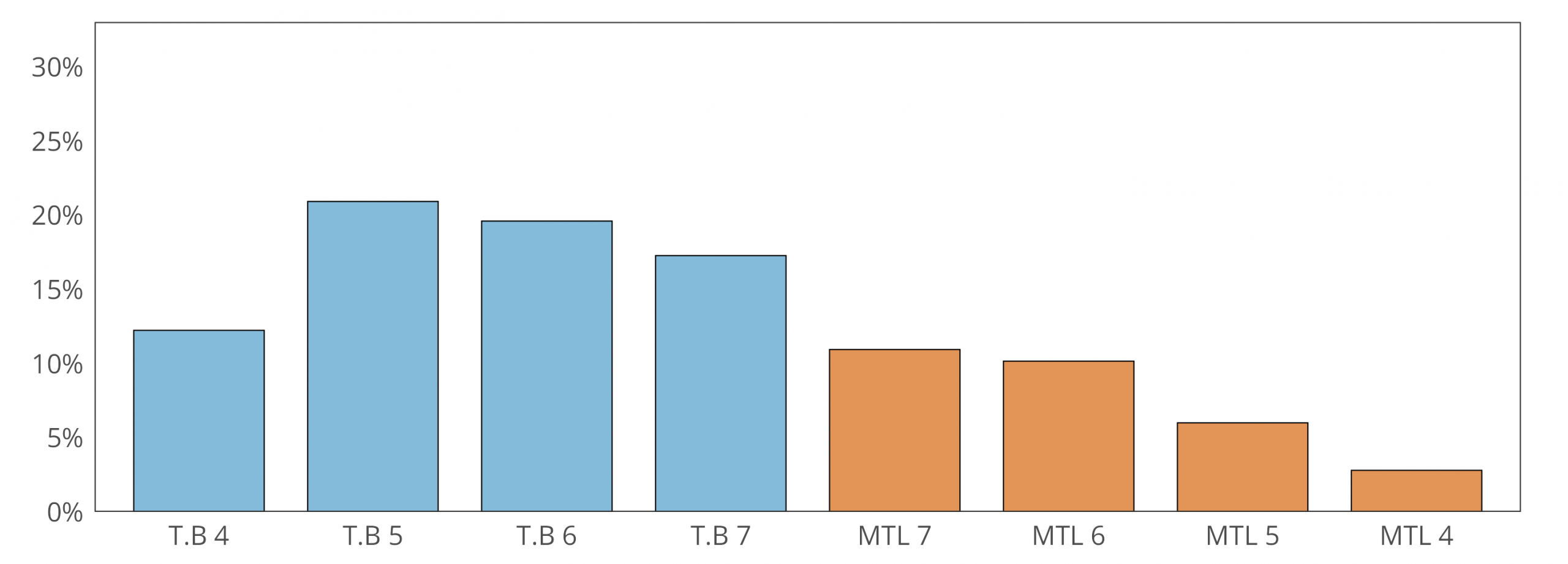
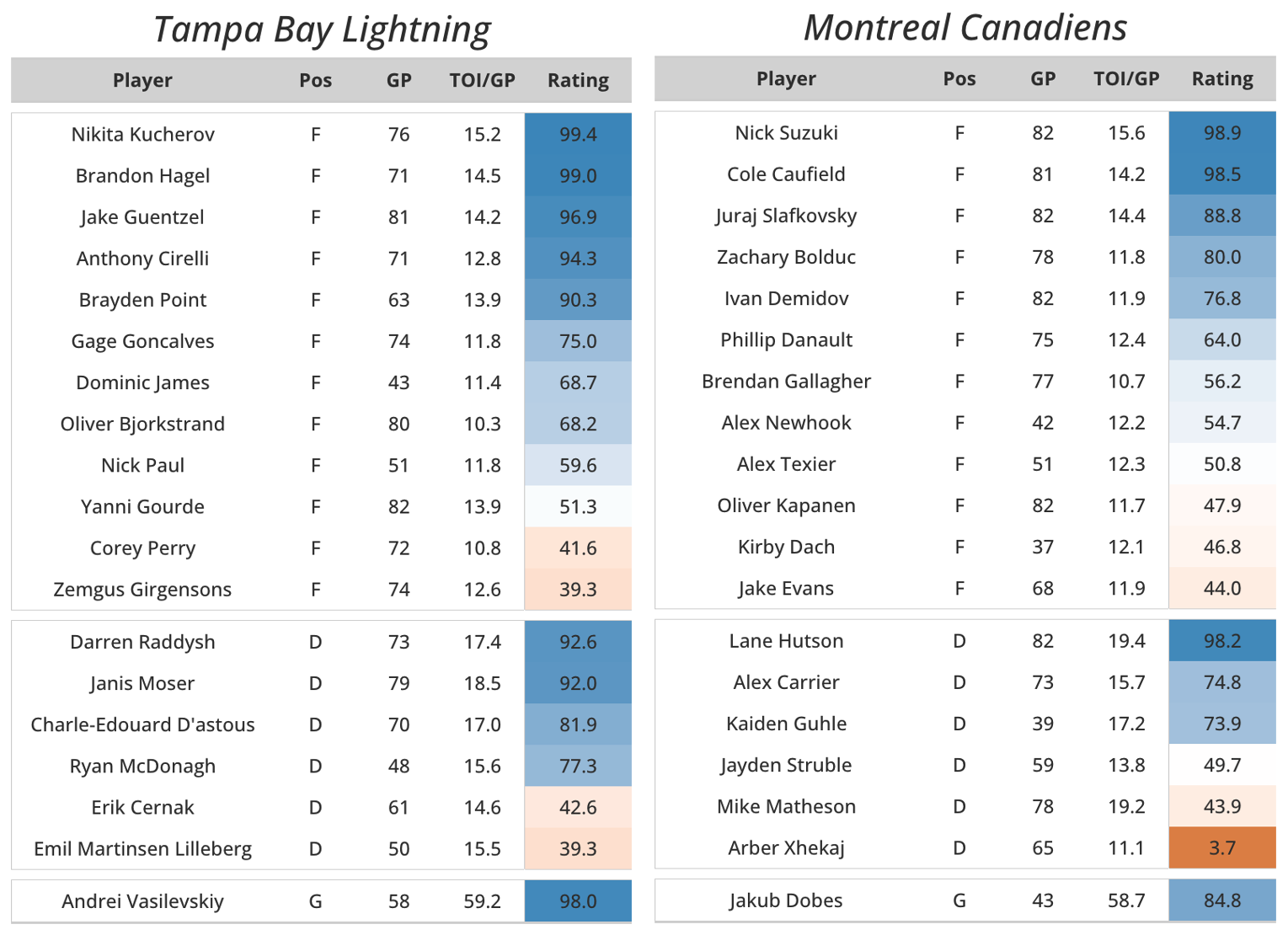
Here we are, once again, talking about the irritatingly consistent Tampa Bay Lightning. This team has continued to be a playoff staple, even without an Yzerplan. 2026 feels different for the Bolts: outside of Kucherov and Hagel, newer names carried quite a bit of weight as certain players aged out. Jake Guentzel, in his second season with Tampa since leaving Pittsburgh in 2024, continued his fantastic tenure with the team (third on the team in xGAR). Darren Raddysh had a breakout season, scoring 22 goals (a single-season franchise record for goals by a defenseman), and posting more than five standings points above replacement. Alongside him was JJ Moser, acquired from Utah in the Sergachev deal. While he sits considerably further back in the box score leaderboard, he’s right there with his partner in multiple underlying metrics. While this Lightning team looks and functions quite a bit differently than their rosters did from past years, it hasn’t been hard for the newcomers to fit into the the well-established machine. They’re a team with a recognizable identity: a little bit of grit, a ton of skill, and they make you pay. With perennial Vezina contender Andrei Vasilevskiy in net, it’s hard ignore this Lightning team, even if we’re all bored of them (to be honest, I’ve now moved from boredom to sheer respect).
I’m not sure there’s a team we’ve talked about more on the podcast (go listen!) than the Canadiens this year. They completely exceeded everyone’s preseason expectations, challenging for home ice in the first round. Led by, dare we say, the “Core Four” (Suzuki, Caufield, Slafkovsky, and Hutson), Cole Caufield shined brightest with his nice and shiny 51 goals. He led all forwards in value from xGAR shooting (20.3 goals above average) – the fourth highest mark in the past 15 seasons. Ivan Demidov also had a strong rookie season after playing in a few regular season and playoff games last spring. He sits on the opposite wing of Caufield on the first powerplay unit. With Montembeault struggling to fill the starter role, rookie Jakub Dobes stepped up to take his spot, contributing 7.4 standing points above replacement (tied with Jesper Wallstedt among rookies). This team is fun. They have a few young players with some skill, a few old guys who aren’t as good as they once were, but they were as good once as they ever were (a traditional reference at this point). Youth, scrappiness, and inexperience can be a strength for a team that wasn’t supposed to be here, but their lack of depth and experience is showing in our projections. They’ll likely struggle in the defensive zone where their aggressive man-to-man style at 5v5, which lacks layers, will be put to the test by Jon Cooper’s cycling style. Will the Core Four push for more, or will the Canadiens be going home in the first round again?
Carolina Hurricanes (M1) vs. Ottawa Senators (WC2)
73.2% 26.8%
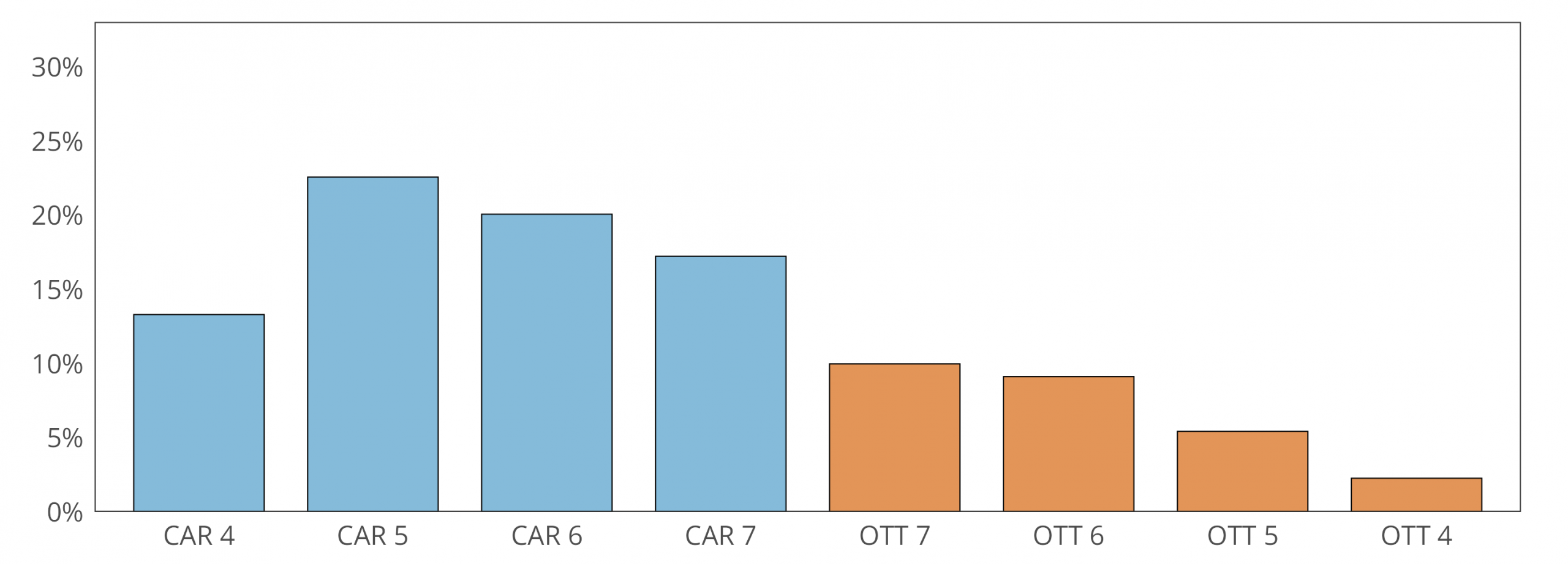
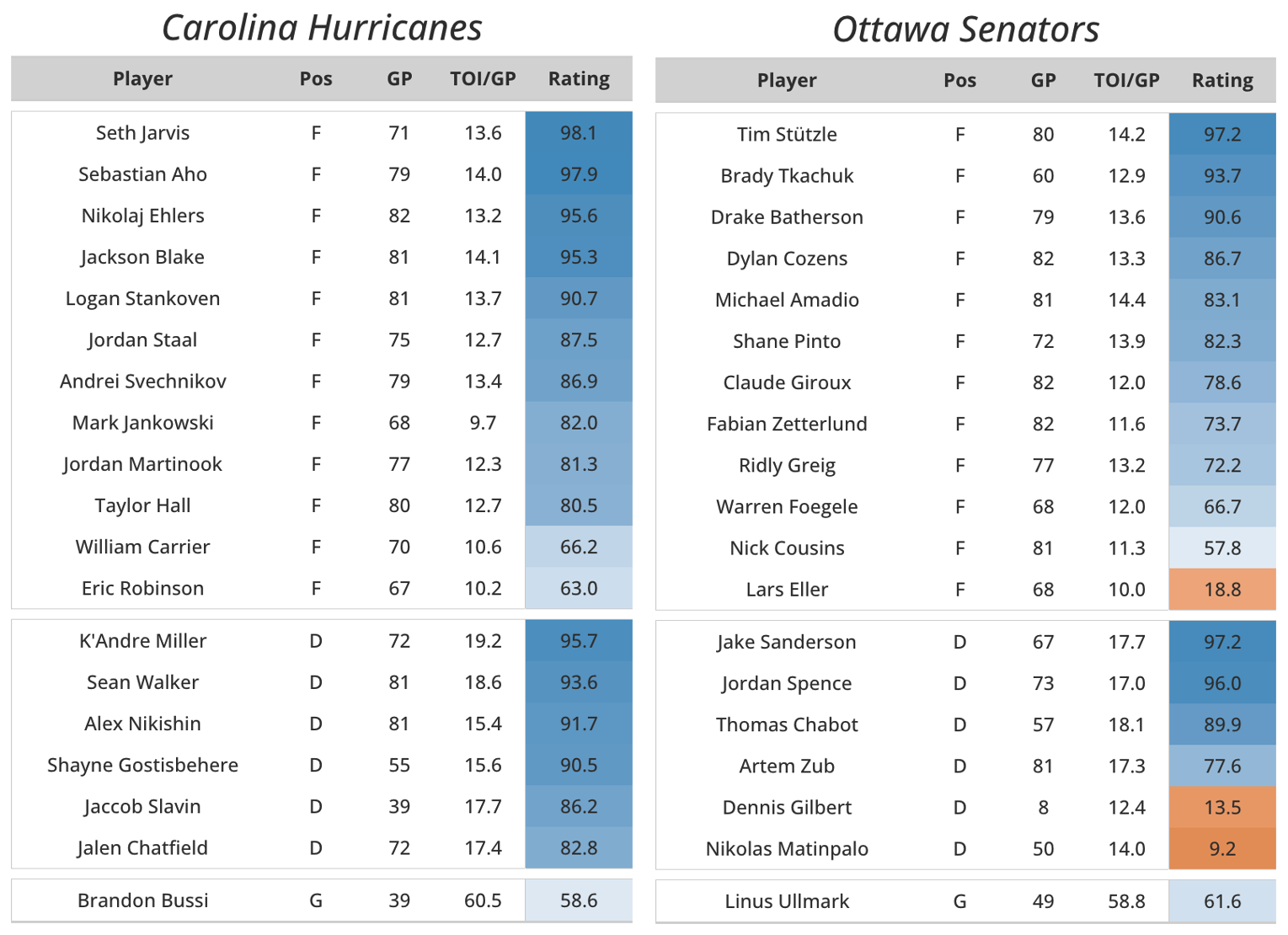
This year is different for the Hurricanes…they have Nic Deslauriers. Unlike last season when Carolina made moves – trading for Rantanen and flipping him to Dallas when things didn’t work – their deadline this year was silent. Can you really blame them? Every season they finish first in 5v5 CF% and top five in xGF%. They score less than expected and allow more goals than expected. It’s more consistent than the Leafs losing in the first round after a solid regular season, except this team can make it to the conference finals. The one major change this season, the X-factor if you will, is the addition of Evolving Hockey favorite Nikolej Ehlers. Signing with the Canes this past summer after an entire career with Winnipeg, he fits perfectly with the team’s style of play: speed, smarts, and playmaking skill. It helped him lead the team in GAR and xGAR with a career-high in points. At times, the playoffs can come down to hot goaltending, something this team isn’t necessarily set up for. Brandon Bussi had his moments this season, but he isn’t a stalwart in net. The model doesn’t pretend it can predict voodoo either, which lends itself to see the good parts of Carolina. Like a habit you can’t seem to break, will the Hurricanes get over their playoff PDO hump once and for all? I mean, it seems really unlikely given the data and the history and the team, but it’s hard for us to look at all that blue and not feel optimistic. Who am I kidding? Carolina enters the first round as one of the strongest teams in the league.
The Senators are sneaky (seems appropriate, am I right?). They’ve been through a significant amount of off-ice drama this season, centered largely around speculation re: Linus Ullmark’s personal leave of absence and Brady Tkachuk’s latest career change to podcast host. They also had to claw their way into the second wild card position despite being tied for fifth in the league in regulation wins. This is a good hockey team with solid hockey metrics. They sit top five in 5v5 CF% and xGF%, and when looking at their team RAPM chart, they are above average in every metric outside of shorthanded goals against. It finally clicked for Dylan Cozens in his first full season in Ottawa after a rough final two seasons with Buffalo. We saw his potential with the Sabres between 2021 and 2023 – the offensive skills were there but the defense was lacking. This season, he arguably took a step back offensively but took a more important step forward defensively. The Senators also found an incredible value in Jordan Spence (acquired last summer). This is a dangerous team entering the first round with a bad draw. The 2026 Sens are better equipped this year than they were in 2025, and if they can punch back at the Hurricanes, they have a real fighting chance despite being the last team in. The model says they don’t, but I kind of like this weird Ottawa team.
Pittsburgh Penguins (M2) vs. Philadelphia Flyers (M3)
62.3% 37.7%
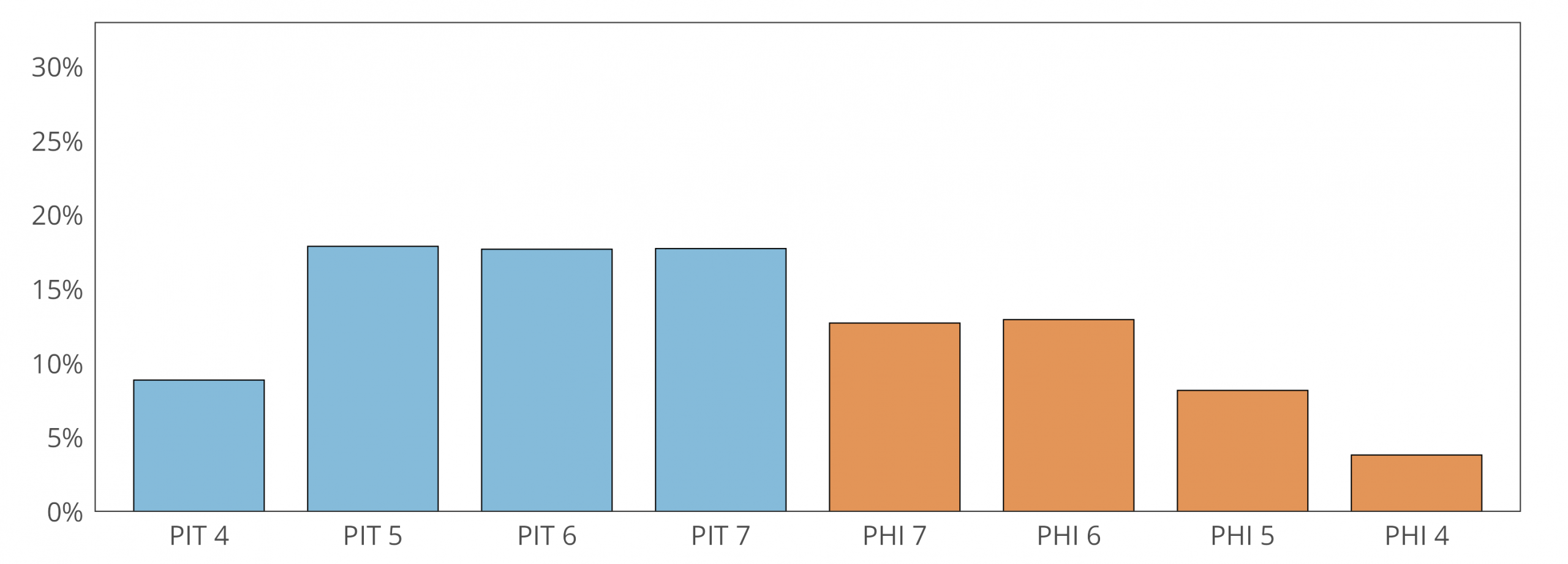
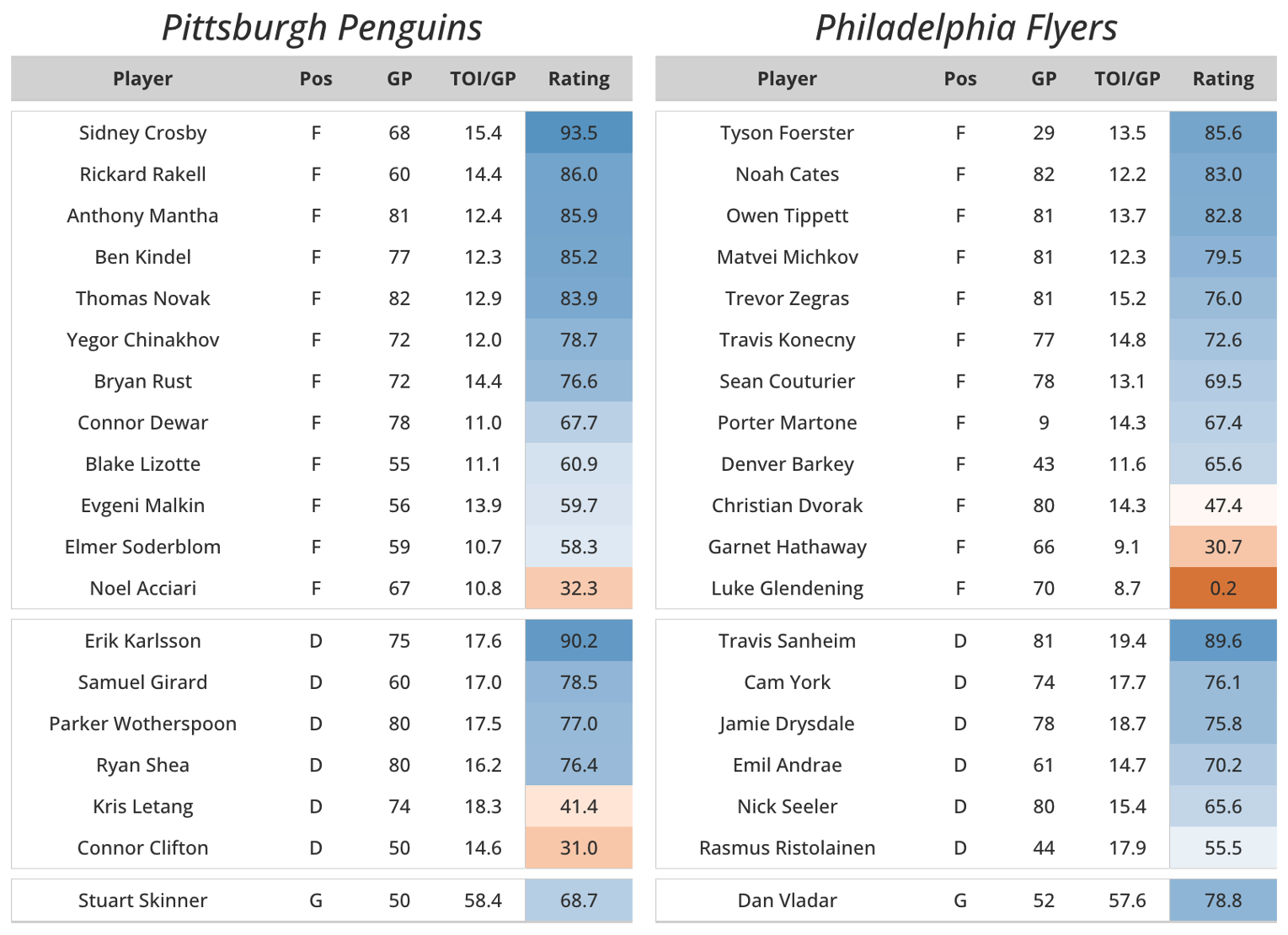
With Toronto in flames, Kyle Dubas and the Pittsburgh Penguins solidified home ice in a first-round matchup. Yes, a dumb division format may have given them an advantage, but lets focus on what matters here: long-time Evolving-Hockey favorite Anthony Mantha. With 33 goals and 5.0 xSPAR this season, it’s safe to say the Penguins wouldn’t be where they are without his help (I mean, you could probably say this about all of their players given the margins). Erik Karlsson and Ryan Shea also had strong contributions in combination with the unstoppable force that is Sidney Crosby, and on paper this team looks quite good. The key (or lack thereof) might be the lack of anchors, or at least none that play considerable minutes. The Penguins have faced injuries and recycled players all year. 34 skaters played at least 100 minutes in a Penguins uniform this season. They also traded Tristan Jarry in the middle of the season for Stuart Skinner who has been fair but unimpressive in his 27 games. Unlike the prior canvases that Kyle Dubas has painted, this one is built on depth. A true test of weak-link versus strong-link if they somehow make it to the conference finals or Stanley Cup Finals. While this team most likely isn’t poised to get that far, they have a good chance against their Pennsylvania neighbor (close enough).
Who would’ve thought we’d be here, talking about the Philadelphia Flyers grabbing a division spot, just having a good time. On March 1, the Flyers were 10 points back of the New York Islanders for third in the Metropolitan Division and six back of the final wild card spot. But a strong finish earned them some extra gate revenue. Trevor Zegras finally had his breakout season after being traded to Philadelphia over the summer. He recorded a career-high in points (67), SPAR (3.9), and xSPAR (5.5). He had a more well-rounded game this season and looked considerably more comfortable. Travis Sanheim had his best season as the key link on the back end, and with a stellar season from Noach Cates (potential Selke finalist) and long-time site favorite Tyson Foerster, Philadelphia enters the first round with some solid depth. And not much more. Like the Penguins (let’s ignore Crosby and maybe Karlsson), there’s not a lot here that one might consider “high-end”. Not even Rasmus Ristolainen. The Flyers are more of young, up and coming team trying to exit a (successful?) rebuild and gain experience. They’re probably here a year or two too soon, but they absolutely earned their spot here. While not poised for a big run, they can put up a fight in the first round, and we all know the NHL playoffs are better when Philadelphia is involved.
Western Conference
Vegas Golden Knights (P1) vs. Utah Mammoth (WC1)
49.5% 50.5%
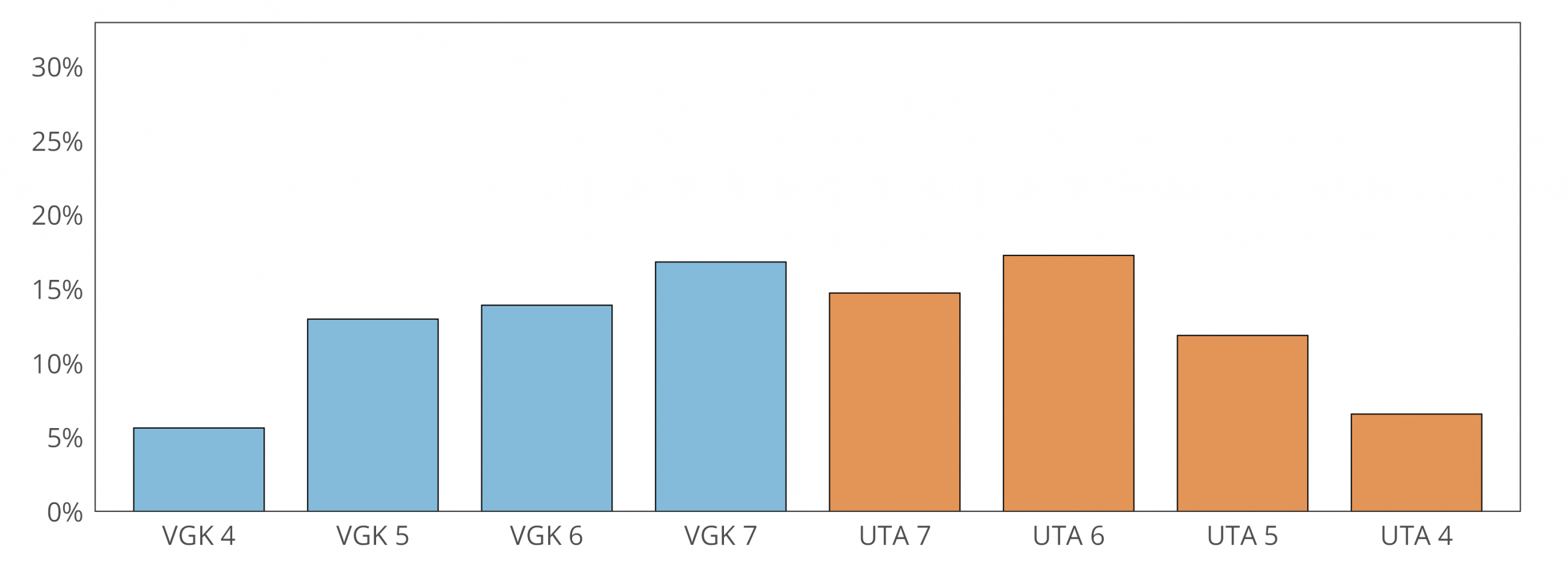
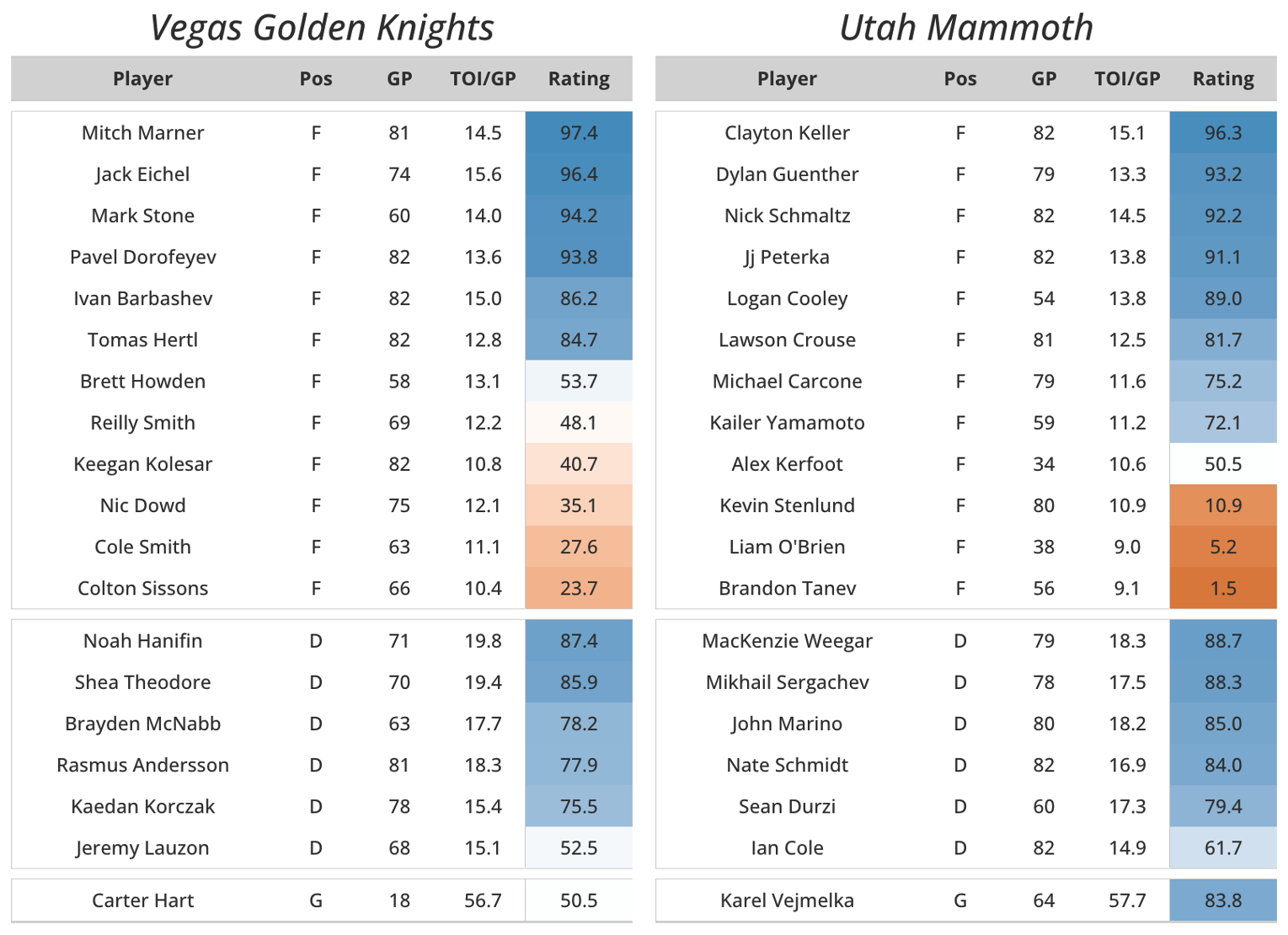
The Golden Knights finished lower in the standings than we projected for the first time in four years (by about 6 points – we take that). We’ve been maligning this anomaly for some time. I mean, we’ve been maligning the Knights since their expansion draft when the NHL made the rules so they were almost guaranteed that several (more?) NHL GMs would either overthink or completely botch their respective protected lists. Regardless, Vegas is still in the playoffs. Imagine a fanbase that’s experienced only one season in nine years that didn’t end in the playoffs. It makes you want to stop being a fan. The Knights are extremely average, but in a good way? With a very strong core group of skaters at the top in Stone, Dorofeyev, Marner, and Eichel (all finishing the season with more than 17 xGAR), it’s a little surprising they struggled to standout in the Pacific. But then you might take a look at the rest of their skaters, or the goaltending… oh the goalies. Of the four goalies that played for Vegas this season, none played more than 35 games, and only one finished positive in GAR (Akira Schmid). After an incredible season last year, Adin Hill struggled heavily, and it seems likely Carter Hart will take the net in first round. While their defensemen are quite solid, the lack of forward depth and goaltending certainty makes them the rare division-winner to land below 50% in our playoff projections. It must be rough for Vegas fans. I can’t imagine what it’s like to struggle in the playoffs.
Unlike the Knights, Utah met our expectations (which were, admittedly, a bit high entering the season). Finishing with 94 points (0.4 points below our projections), the Mammoth proved that they were a force to be reckoned with – at least in the ’25-26 Western conference. The franchise has one playoff appearance since 2012, and they’re entering the 2026 playoffs for the first time in six years. While their record might be underwhelming, they exemplify a trend among middling western conference teams: strong even-strength underlying numbers. 5th in EV RAPM CA/60± and 6th in EV RAPM xGF/60±, this feisty team brings with it a spirit for winning just enough games, with little flare to get them where they need to be. A surprisingly solid top-6 centered by Schmaltz and Cooley with Guenther and Yamamoto on the wing, Utah’s top-end is not the concern here; their depth raises eyebrows. With possibly the worst fourth line entering the playoffs, and a very questionable current 3rd line (it’s moved around a ton but Utah lost the Peterka trade??), there are some real issues here. However, given that their opponent faces similar issues, this ends up being the closest series in the first round per our model. I’m rooting for Utah because we were more right about them before the season started and I also dislike Vegas quite heavily. Although it would be funny if Marner was really good and Leafs fans had to watch that. Ok, sorry, that was mean.
Edmonton Oilers (P2) vs. Anaheim Ducks (P3)
63.0% 37.0%
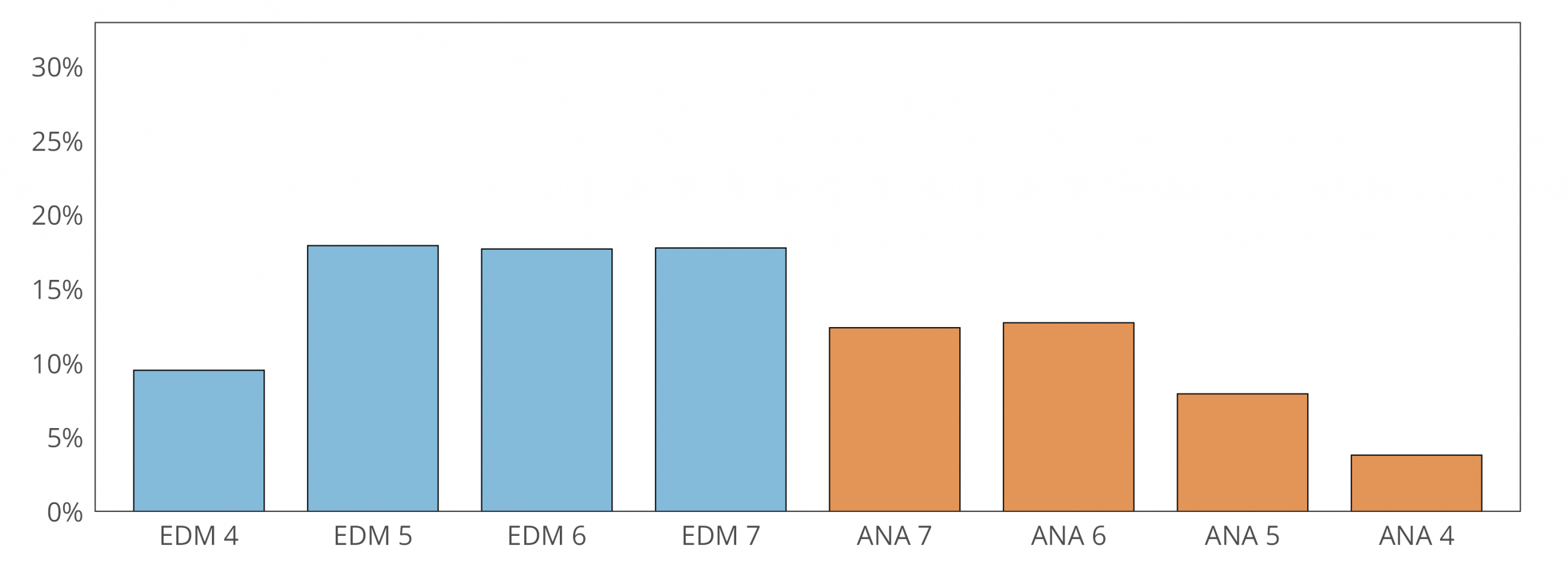
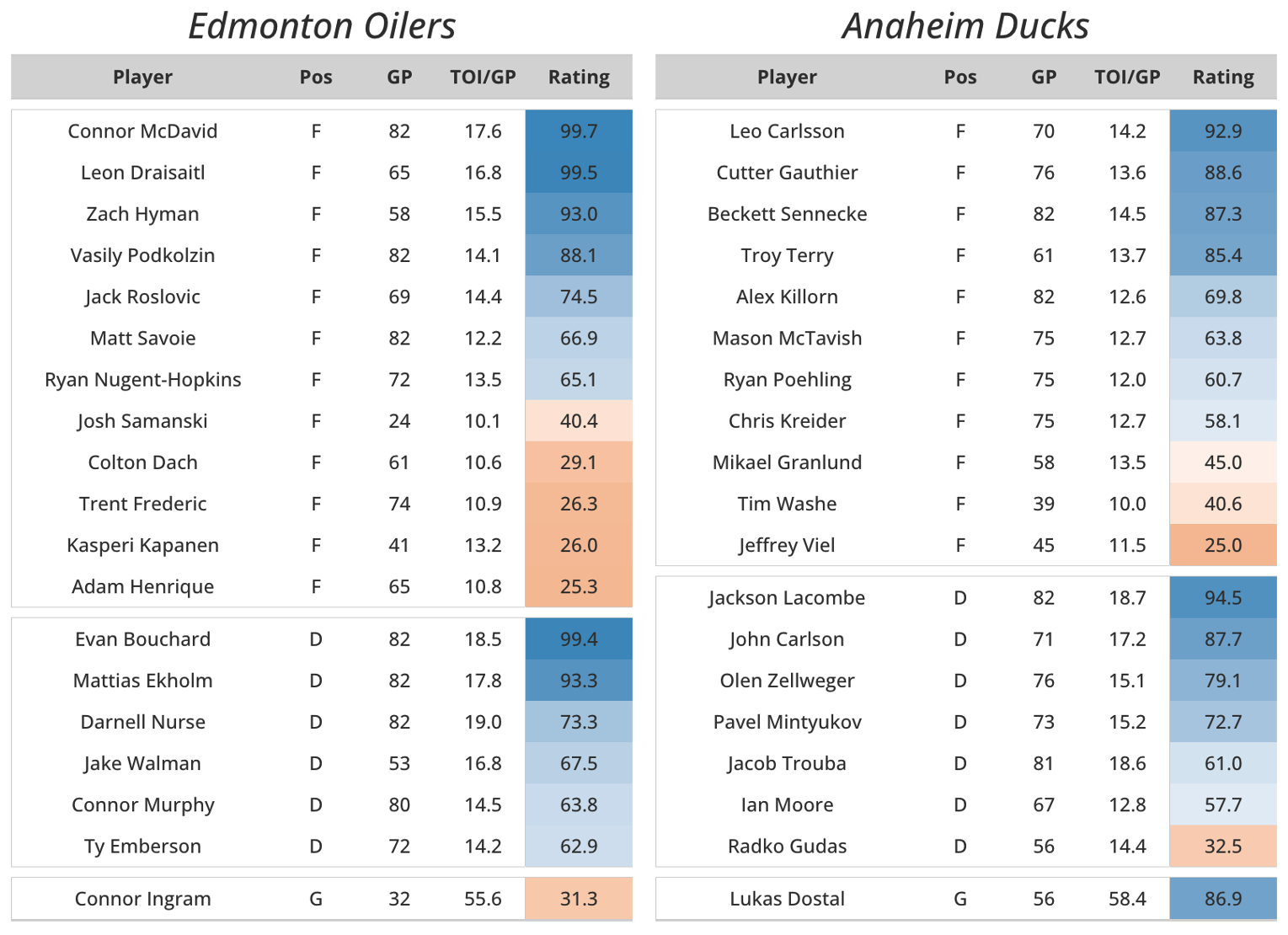
It’s hard to overstate just how disappointing the Oilers’ season was this year. Finishing 17 points below our preseason projections, it’s difficult to fathom how a team with this many really good players could underperform so heavily. Luckily, they still play in the Pacific, where 93 points is good enough for second in the division. That’s sort of insane to type out. The ’25-26 Edmonton Oilers may just be the most top-heavy team I’ve ever seen, and when I say top-heavy I mean like a hammer. The combination of McDavid, Draisaitl, and Bouchard on one team is sort of unbelievable this year (all finishing with more than 20 xGAR) – however, they’ve somehow reverted back to their prior form from a few years ago: there’s no one else. Among their available skaters this season (~200 min. TOI), 16 of their 26 skaters finished the season with 1 xGAR or less, and only 8 of those 26 skaters finished the season with a positive RAPM CF±/60. With the lack depth the Oilers had this season, they understandably relied on their hammer head heavily. Among their 10 most common forward line combinations this season, McDavid played on half of them, and Draisaitl played on four of them, leaving only the Howard/Roslovic/Savoie line with more 60 minutes together among this group. Goaltending proved even more difficult; while Jarry has had his moments in the past, they didn’t happen here. Connor Ingram was fine, but a team’s number #1 playing only 32 games while posting 6.2 GAR is not the kind of confidence you want heading into the first round. That said, that hammer head is insane. At the very least, this haphazard team has McDavid and gets to face one of the most chaotic teams in the playoffs.
The Anaheim Ducks. Entering the playoffs for the first time since 2019, they’re almost an inverse of the Oilers. Finishing 16 points above our preseason projections with a core of rising stars in Carlsson, Gauthier, and Lacombe, no one except the smattering of Ducks fans in our mentions from October thought this team would amount to much. Now, like the Oilers, 92 points and third in the Pacific is, once again, not that much, but they’re here with a chance. A team comprised almost entirely of even-strength offense and nothing else (all of their other team RAPM metrics aside from EVO at all strengths are below average), and with close to 10 regulars below-replacement in GAR and xGAR, the Ducks have their work cut out for them. There are some glimmers of hope here: two of their regular forward lines finished among the top-50 in on-ice xGF% (min. 125 TOI), and their young talent is extremely promising and mostly fun. Leo Carlsson has been superb this year, and potential Calder finalist Beckett Sennecke performed quite well. Like the Oilers, their issue is goaltending. After a phenomenal season last year (25.2 GAR, 9th in the league), Lukáš Dostál struggled relative to expectations posting almost -5 goals saved above expected in April (I should know, he along with Shesterkin and Skinner lost me my fantasy championship). This series is going to be ridiculous if for no other reason than neither of these teams should really be here. But they are, and we’re going to watch them because I like messy hockey played after midnight.
Colorado Avalanche (C1) vs. Los Angeles Kings (WC2)
89.3% 10.7%
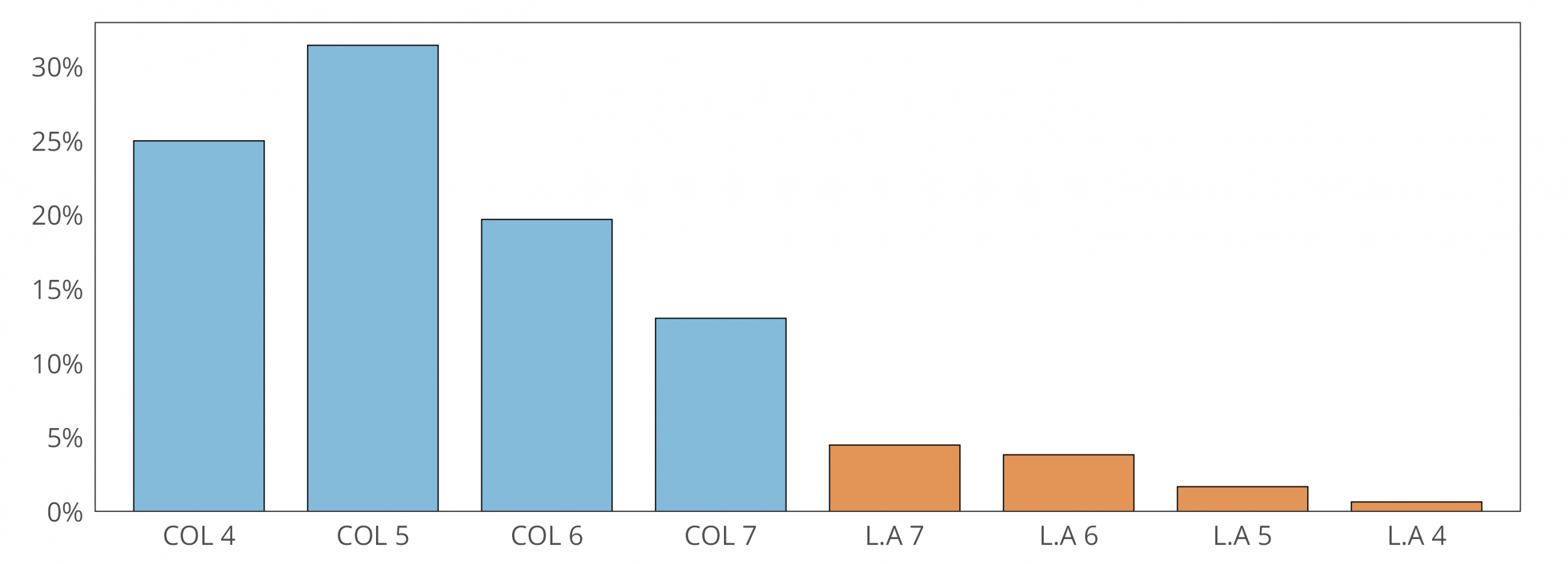
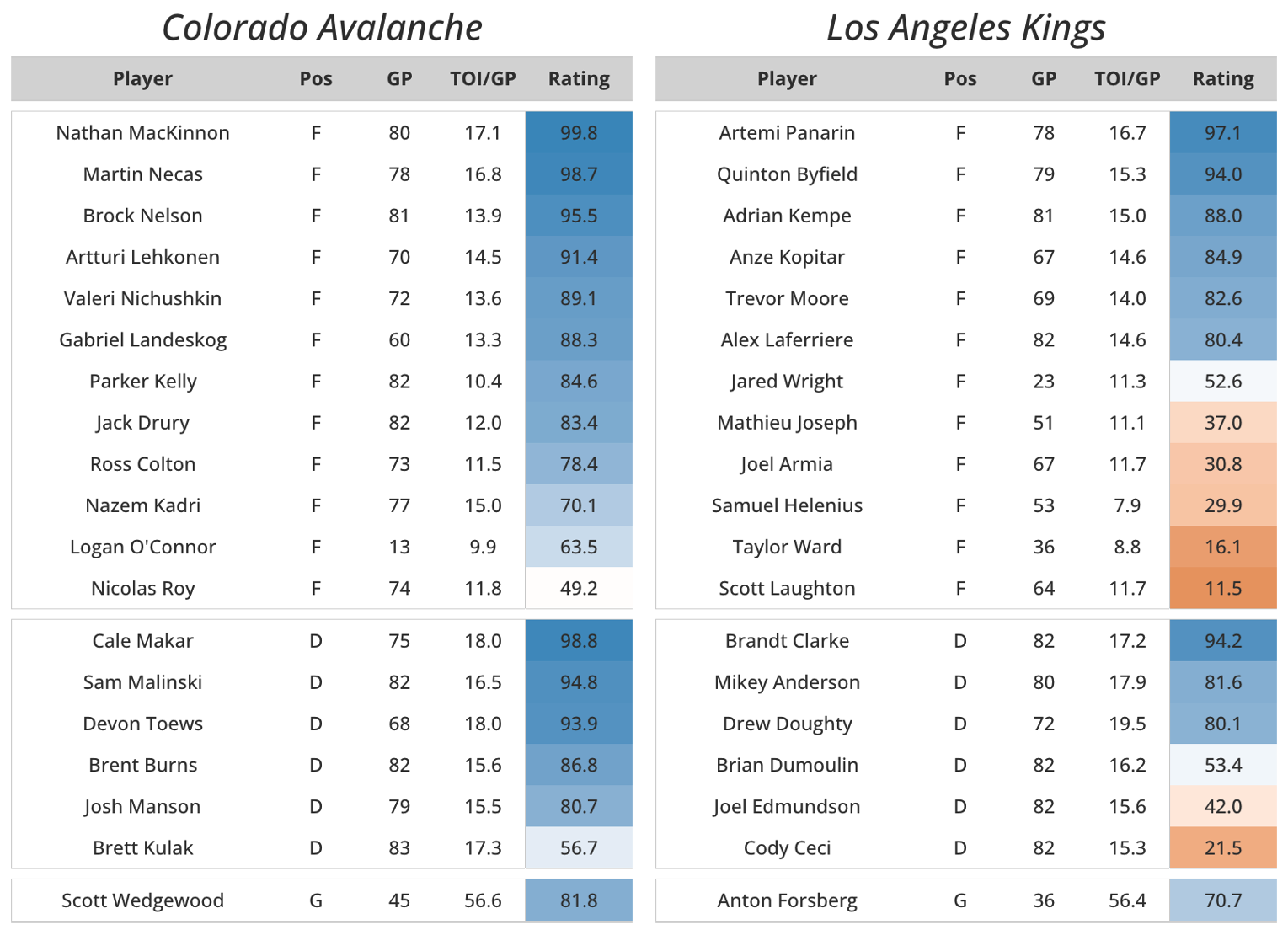
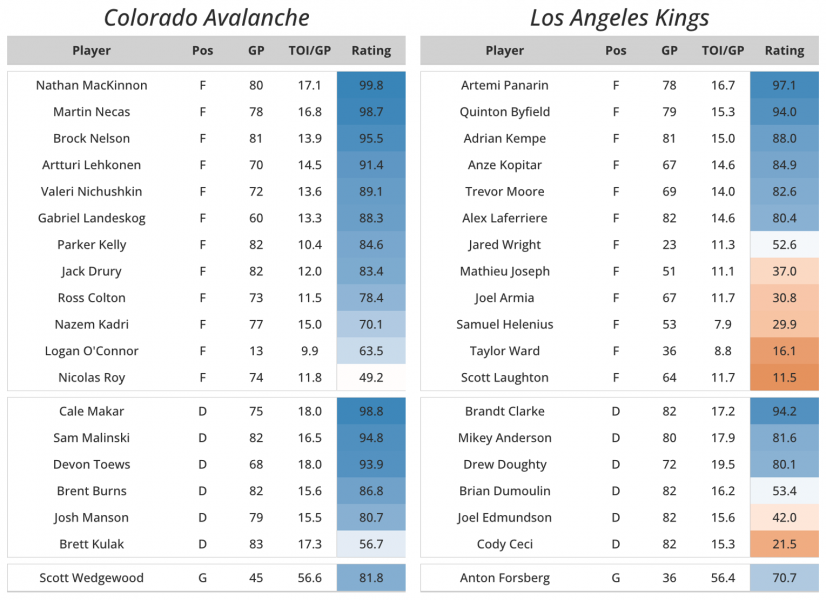
I mean, we all know the Avalanche are supposed to win the Stanley Cup this year, right? They beat our preseason projections by 10 points (no team had a higher standings point projection heading into the season), put up 52 team GAR more than the next team in ’25-26, and now rank 5th among all teams in the same stat (season-adjusted) since 2007 – no other team from this season finished in the top-50. I’m actually a little scared for Luke to run the simulation for our playoff projections because I’m writing this before he’s finished it, and I have a hunch this might be the most lopsided series we’ve seen in years (later: it is, in fact, that). Colorado’s put themselves in a scenario that feels eerily similar to Tampa Bay in 2019. Sure, their opponent is quite a bit different, but the level of expectations here is on a level that’s almost burdensome. Hell, when my neighbor asked me who I thought would win the Cup I sort of shrugged and just said the Avalanche and she said “yeah…”. With only one regular skater below replacement (Gavin Brindley), both a Hart AND Norris contender (even if he really shouldn’t be), the ’25-26 Avalanche are the beacon of hope (?) among a sea of misfit toys. Or something. I honestly don’t really know what else to say this year. It’s like they’re the Oilers from the last few years, but the rest of the lineup is like the Hurricanes. I don’t know… What do you want me to say here? That there are chinks in the armor? There aren’t. No one should beat this team. But it’s the NHL playoffs, and a Jake Allen or Sergei Bobrovsky seems to always lurk when the time is just right.
Anton Forsberg? Is it your turn to destroy hope? Probably not. The Kings aren’t supposed to be here. Honestly, no one in the Pacific is supposed to be here. I’m just going to say this again because it’s funny: the Kings finished ’25-26 with 22 regulation wins. 29 teams had more regulation wins than the Kings, and the Blackhawks, who finished with the same number of regulation wins, had 18 less points. Just think about that for a minute. Maybe a few minutes. It’s almost like this team was designed, down to its core, for overtime. The irony here is that they aren’t that bad. Top-10 in both EV RAPM CF±/60 and xGF±/60, it’s almost implausible this outcome would occur. Bottom-5 in EV shooting % and top-5 in EV save %, I’m not sure we’ve ever experienced a team that was this boring. Ok, my Wild viewing days started around 2011, so maybe that’s the timeline for this. With only one player finishing this season with more than 10 xGAR (Byfield, 12.6), and only ~5 regulars below replacement, L.A. created the perfect blend of players to middle as hard as any team could ever middle (I can use “middling” this way, right?). 33-year-old Anton Forsberg has been quite good for this ridiculous Kings team, and part of me wants to find hope. Hope does not spring eternal. Man never is, and the Kings are not blessed.
Dallas Stars (C2) vs. Minnesota Wild (C3)
57.5% 42.5%
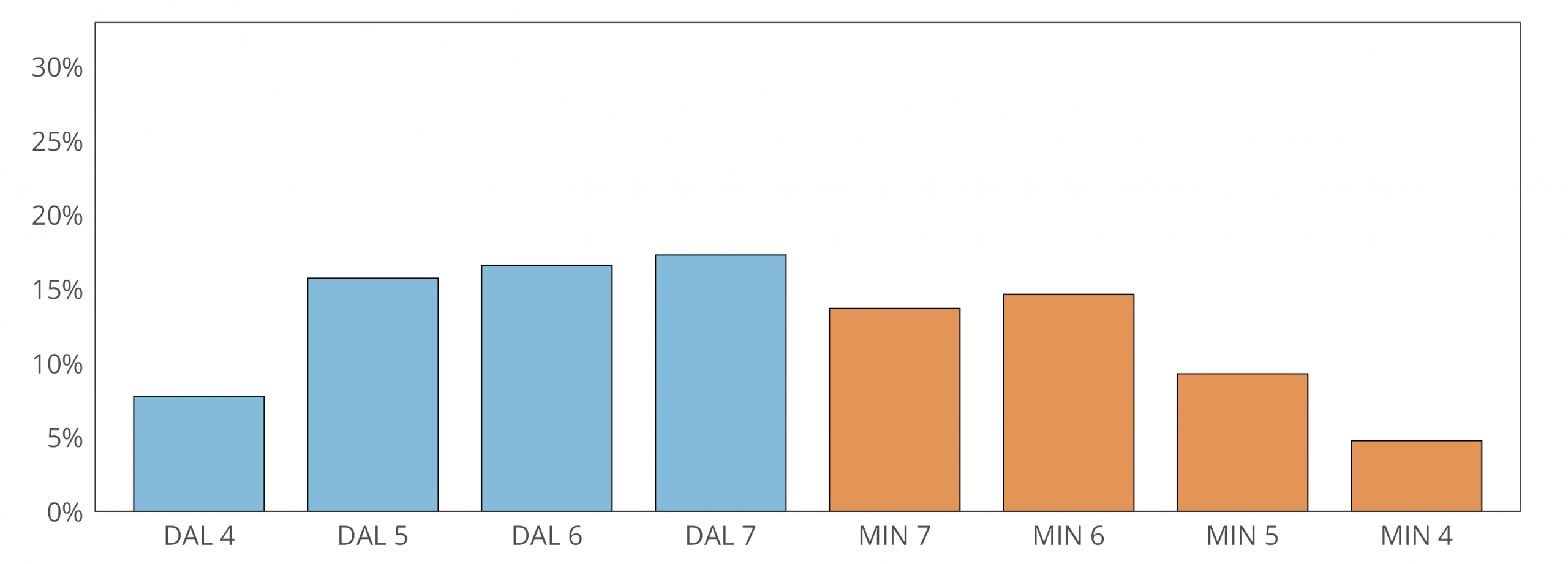
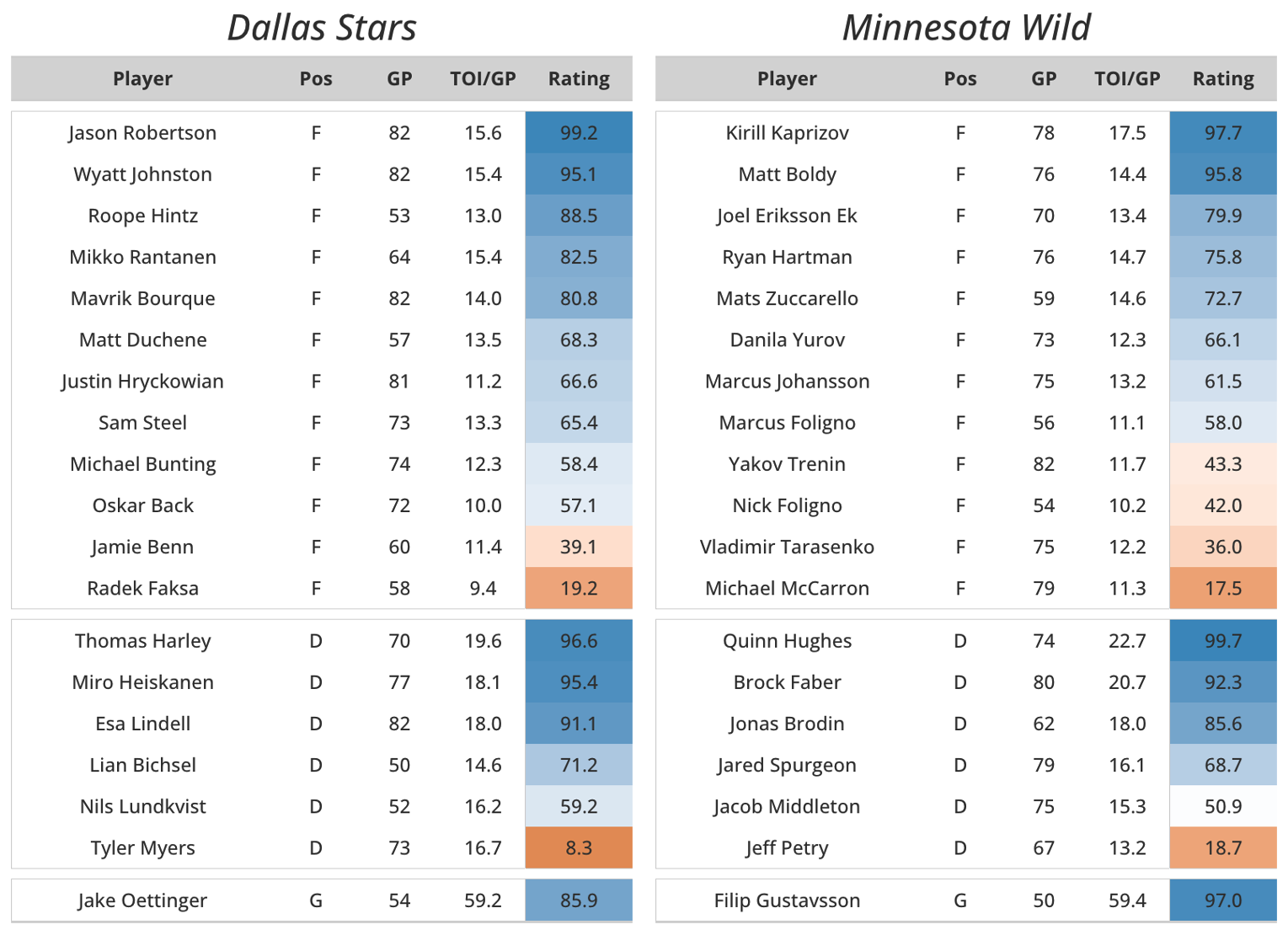
And now we arrive at, arguably, the best matchup in the first round (or the most unfortunate depending on the angle you’re looking from). And personally, I’m not ready to watch this. I don’t know if I can go through it. For months, the Central division has had three of the strongest teams in the standings, and it’s been practically guaranteed that Dallas and Minnesota would play in the first round. The Stars have been one of the most successful teams in recent years – advancing to the conference finals the past three seasons. In theory, this Stars team is quite similar to those prior teams, they’ve just arrived at those theoretical results in different ways. With possibly the best center depth in the league and one of the best defensive pairs in the game, it’s hard to see how they shouldn’t be considered one of the true contenders from the West (ignoring the Avalanche). Interestingly, the Stars’ results in the standings are not necessarily backed up by the typical underlying numbers we see from great teams. 22nd in EV RAPM CF±/60 (11th in the xG counterpart), a good chunk of their success can be attributed to that good ol’ combination of shooting (4th EV) and saving (7th EV) in arms with a lethal powerplay (2nd in PP RAPM GF/60 behind only the Oilers). The real secret for this team has been extremely under-covered depth in players like Mavrik Bourque, Justin Hryckowian, and Sam Steel; given Dallas’ multitude of injuries (Hintz, Seguin, Duchene, Bastian), they’ve found real value in several overlooked players that have allowed them to thrive. In net, Oettinger and DeSmith makeup one of the best tandems in the league behind only Colorado and Minnesota. Speaking of.
Oh, the Minnesota Wild. Everyone loves us, it’s finally our time, The Future is Now(TM). Is it? As some of you may remember, Luke and I spent a good chunk of the first half watching other teams (cough, the Buffalo Sabres, cough), but we found ourselves in a position where the Wild were actually good, and my Dad was starting to get mad that he couldn’t talk to us about the team. Since we started regularly watching the team again back in January, I can attest to the slogan. The Future might be now. Or it could be in the future, which, by definition, is where it’s supposed to be so I’m not really sure what they’re trying to get at there. With the blockbuster addition of Quinn Hughes in December and the continued rise of their in-prime core, there’s a lot of hope here in Minnesota for NHL hockey. That scares me. The Wild possess one of the better powerplays in the league (behind only Dallas in PP% – I don’t like this metric but I’m using it to convey perception – they are top-10 in all of our RAPM offensive metrics), one of the best top fours in the league even if Spurgeon and Brodin refuse to age, and possibly the 2nd best set of goalies in the playoffs. If Minnesota has a weakness, it’s the same weakness they’ve always had: depth. While the rookie-addition of Yurov helped, there are still some question marks among Middleton, Petry, McCarron, and Trenin. We’ve picked Gustavosson as the starter here due to seniority, but it really seems like it could be a toss up. Regardless, this is possibly the best Wild team we’ve seen in the playoffs in 9 years (don’t remind me how that ended), and there are some real reasons to be hopeful. And I hate that for me and also for my Dad, who is fully bought in. So much so that I think my mother is legitimately concerned. This series is going to be a blood bath, and I personally can’t wait for it. I don’t have a choice.