We witnessed the full spectrum of Hockey quality in the first-round this year. From DAL/MIN to EDM/ANA, TB/MTL to PIT/PHI, every kind of Hockey was available, through multiple streaming services, just a click away. And somehow through all of this, only one series will end in its seventh game (the TB / MTL finale happens tomorrow). Colorado and Carolina, somewhat unsurprisingly, swept their respective series and head into the second round of the 2026 NHL playoffs as the clear Cup favorites from each Conference. America’s Teams (the Minnesota Wild and Buffalo Sabres) are moving on to the second round for the first time in 11 and 19 respective years, Vegas continues to annoy us with their perseverance, and I sort of just feel bad for the Oilers. The second round will feature multiple heavy underdogs (PHI, MIN), young messy teams that weren’t supposed to be here (ANA, PHI, BUF), and a team that we don’t know yet because I’m writing this on short notice because we’re overlapping the rounds for some reason.
If I was more inclined to clickbait or we could incorporate flashy thumbnails and had a YouTube channel with tons of subscribers, you might see “EMERGENCY PREVIEW” in big red letters somewhere amongst all that. Luke and I found out the second round was starting today maybe like 10 hours ago (probably that’s on us, but still)? Our process is not set up to easily run the playoff simulation while any given round is still ongoing. That said: we only want what’s best for our lovely readers and subscribers, so we made it work. Don’t you love us? I do. All joking aside, we’re going to be releasing our previews in this article one-by-one, roughly, while everything gets sorted out with the strange schedule. I don’t want to complain here (ok, obviously I do), but overlapping playoff rounds is a really good way to collapse storylines, confuse fans, and make things way more complicated than they should be. Not trying to overstep my influence, but if the league needed to ensure a Saturday night primetime game, maybe they should’ve started the first round a few days later? Like we’ve been saying. For three years. Just throwing this out there. Ok, rant over.
CAR / PHI is below for the time being. We’ll have COL / MIN and VGK / ANA up tomorrow morning. Boy is this second round going to be weird? Let’s get weird. I might even update the above section once I get a better vibe for what the second round will be like. Probably not. But I might.
Let’s recap:
| Conference | Home | Away | Round 1 % | Outcome |
|---|---|---|---|---|
| East | CAR | OTT | 73.2% – 26.8% | 4-0 |
| East | BUF | BOS | 63.7% – 36.3% | 4-2 |
| East | T.B | MTL | 70% – 30% | 3-4 |
| East | PIT | PHI | 62.3% – 37.7% | 2-4 |
| West | COL | L.A | 89.3% – 10.7% | 4-0 |
| West | VGK | UTA | 49.4% – 50.6% | 4-2 |
| West | DAL | MIN | 57.5% – 42.5% | 2-4 |
| West | EDM | ANA | 63% – 37% | 2-4 |
Eastern Conference
Carolina Hurricanes (M1) vs. Philadelphia Flyers (M3)
86.9% 13.1%
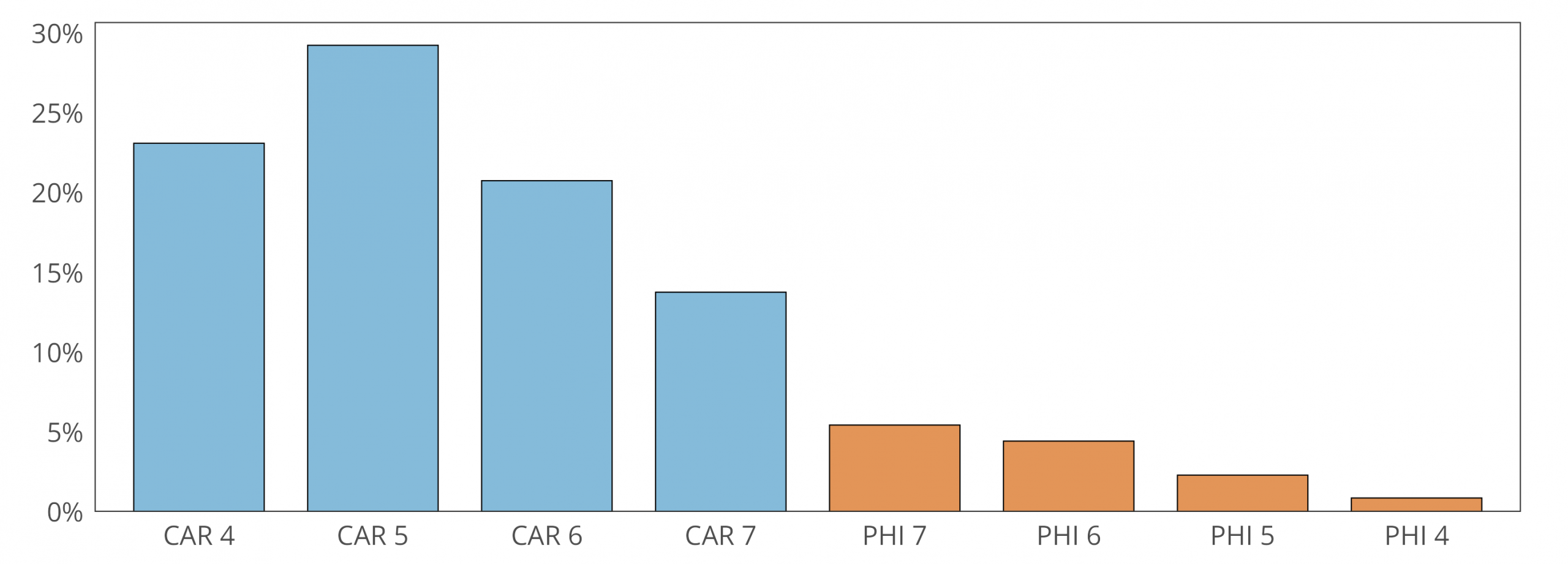
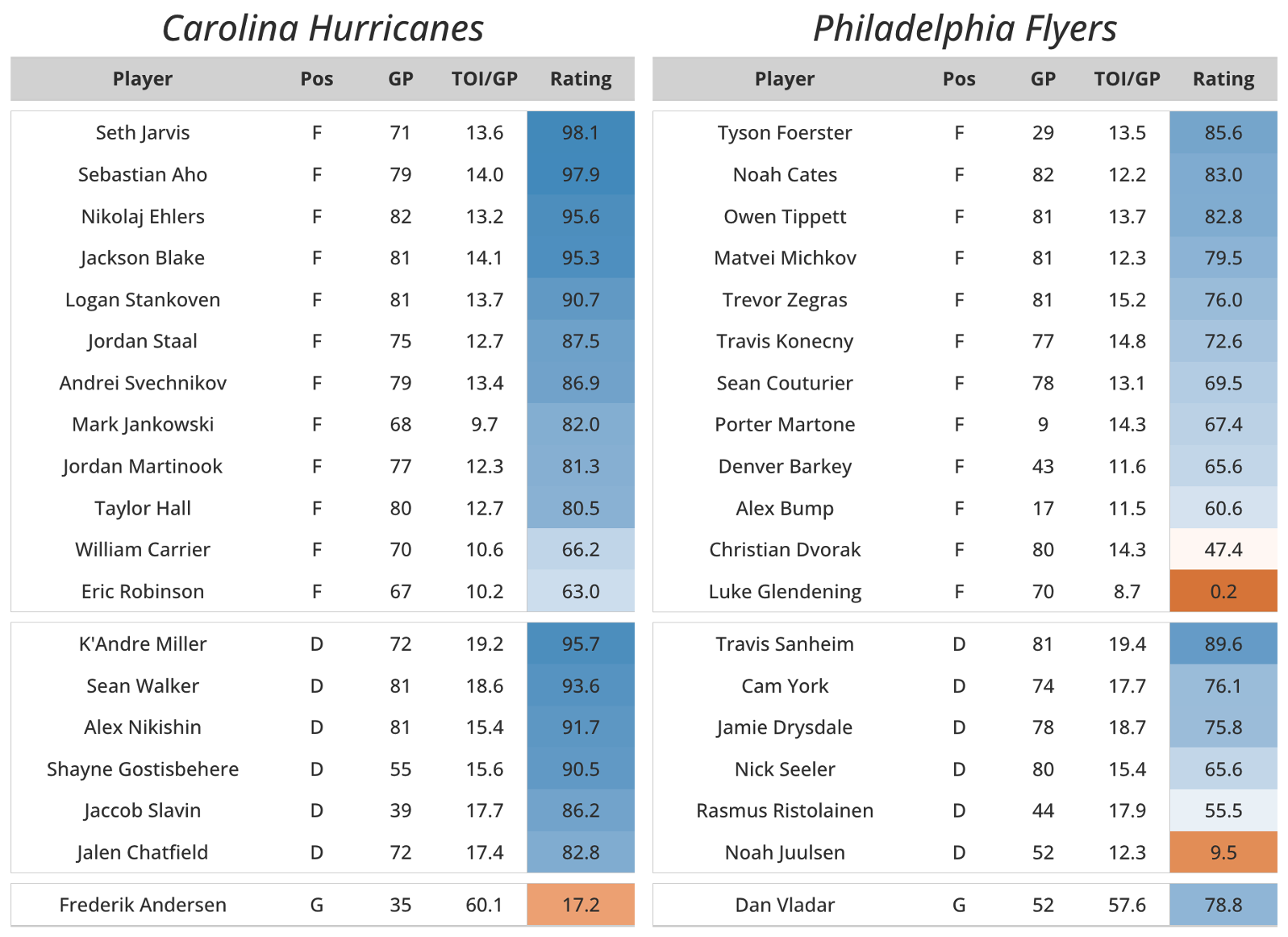
People are just bored of the Hurricanes at this point. I’m not, but people are. Throughout this past season, it felt like we as the collective general NHL-observer (I’m talking about all of us who are writing and reading this) just kind of stopped talking about the Canes during the regular season. Maybe the Avalanche overshadowed them, or the drama in the Metro was more interesting than their inevitable 113 standings points. Regardless, I was somewhat taken aback with our visualizations for their roster in our round 1 preview, but I shouldn’t have been. With the Senators drawing the short straw for their first-round opponent, they put up about as good a fight as you might expect from a team that didn’t win a game. Surprisingly, the Hurricanes didn’t actually lead in any of the standard on-ice EV metrics after a regular season of leading in all of them. There isn’t another team coming out of the East as strong as the Canes, and their roster here shows it quite clearly. That said, Frederik Andersen has a glaring amount of orange among the sea of blue in the roster above. We’ve discussed this at length in prior playoff years, but our models do not think highly of goalies over the age of 35, even if they still perform well sometimes (Fleury, Smith, Bobrovsky, Andersen, Anderson). Carolina’s choice of going with the veteran paid off. With 9.7 Goals Saved Above Expected (behind only Ullmark’s 10.05), Andersen was one of the main reasons the Canes were able to sweep in the first round. The model might not like him, but he clearly doesn’t care what any model thinks. I’m getting tired of writing this, but this Hurricanes team is scary.
The Philadelphia Flyers weren’t even supposed to be here today. Yet the little team that could from Pennsylvania defeated actual legends with none of their own. The Battle of Pennsylvania represented, I think, what the state encompasses: the bizarre. Philadelphia finished the first round with the lowest EV CF% and 5th lowest xGF% among teams in the first round, only one player with more than four points (Rasmus Ristolainen), and the second highest short-handed CF/60. Entering the first round as relatively heavy underdogs (38% chance), the real story for Philly was their goaltending. Dan Vladar (their only starter) saved 8.5 goals above expected while facing the most Fenwick and xG at even-strength among all goalies in the first round. The Flyers are a legitimately fun and messy team that drew the long straw with their first-round opponent, even if the Penguins made things interesting towards the end. Their second-round opponent, however, is a different kind of beast. With a surprising amount of depth despite little “star” power (I’m biting my tongue re: Foerster and Cates), Philadelphia needs to harness all their other power as a city and get bizarre. I’m talking Gritty freezing actual Hurricanes in the stands like The Day After Tomorrow. You know that movie where Jake Gyllenhal plays a High School kid while looking 27 and then Dennis Quaid comes and saves him? We need Dennis Quaid to save the Flyers and freeze the Hurricanes. Pretty sure the movie happens out there on the east coast somewhere.
Buffalo Sabres (A1) vs. Montreal Canadiens (A3)
47.3% 52.7%
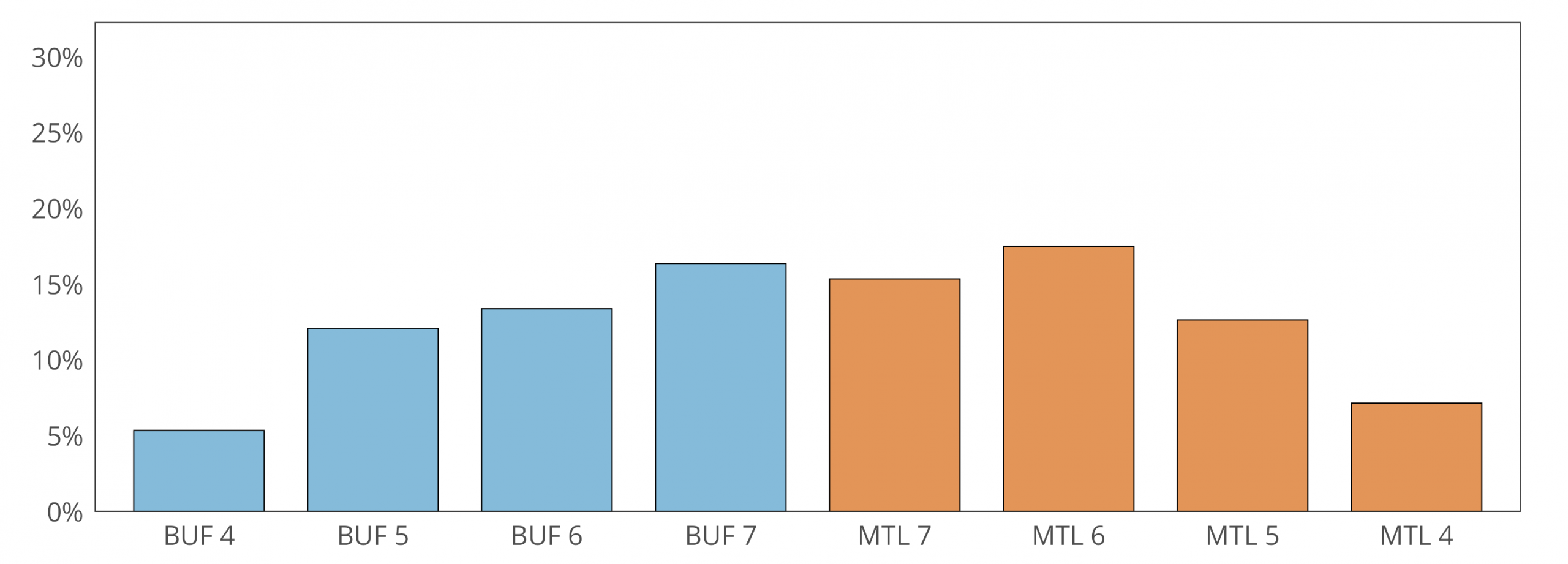
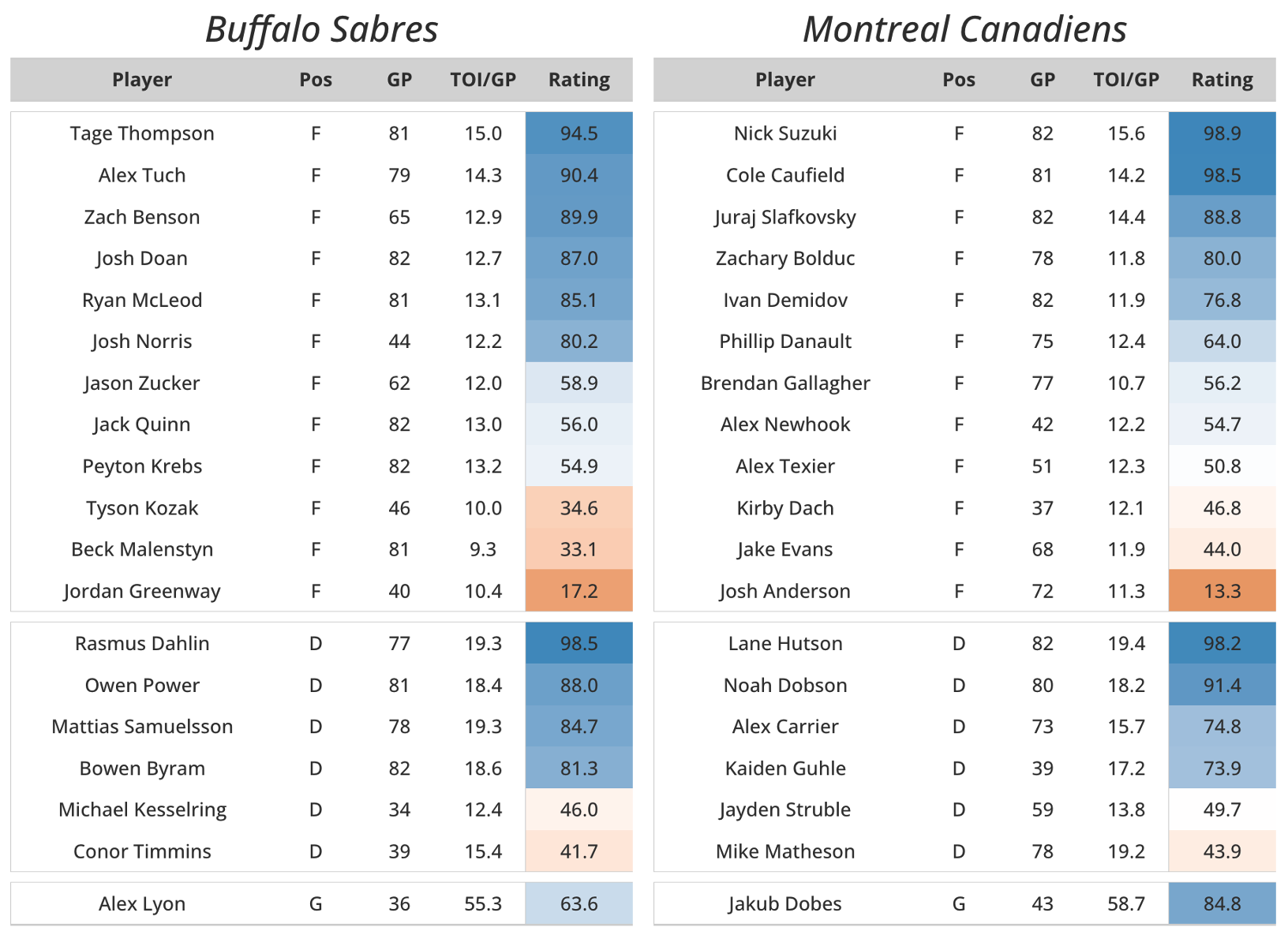
The Sabres didn’t get startled in the first round against a weak Bruins team. Sure, they probably wanted to finish things off at home in front of their fans, but now they haven’t been sitting around as long. Josh Doan has been a real story for the Sabres in the first six games of their postseason. Like a large majority of Buffalo’s roster, it wasn’t clear how Doan’s game would translate to the playoff environment, but he hasn’t missed a beat. While not necessarily related, it helps that his line controlled over two-thirds of the expected goals at 5v5. We started with Doan to lead into the actual true pest: Zach Benson. Supplemental discipline was almost certainly warranted after his slew foot at the end of game six, but Charlie McAvoy’s reaction tells you all you need to know about how effective Benson was in his role. Is there another player that resembles Brad Marchand quite like Benson in 2026? The Bruins’ tried to form a narrative that this young Sabres team would fall apart when it came time for the playoffs. That they were inexperienced, that Zach Benson was only a rat but not a pit bull, that they play “pond hockey” prone to collapse when things got hard. Either that’s not true, or things haven’t gotten hard (yet). Buffalo’s skaters showed us that they’re completely capable of gaining playoff experience quickly. We also saw a goalie change in the middle of the series with Alex Lyon taking over for Ukko-Pekka Luukkonen (right now it appears the Sabres will continue with Lyon to start). While the Sabres would probably prefer to have a clear number one, it really only cost them one game (almost two!). After a taste of first-round success for the first time in 50 years, it’s pretty clear this Sabres team wants more.
The first round series between the Canadiens and Lightning was one for the ages. Every game was decided by one goal, and as Jon Cooper said after game six, the last game in Montreal simply didn’t need a goal. It was perfectly played by everyone, and the goal was simply a means to an end so everyone could go home. That doesn’t happen without Jakub Dobeš, who helped secure a 2-1 win in Tampa on Sunday despite getting heavily out shot. The model likes him a lot (even for a rookie), and his performance backs that up. This Canadiens team really is just good at pushing through adversity. After game two, Kirby Dach had to delete his Instagram account after receiving harassment online for his overtime mistake and then played a large part in the Habs’ game-three victory in Montreal. Arber Xhekaj managed to play well on the bottom pair, stepping in during Noah Dobson’s absence, with a 57.5% share of shot attempts and 80% share of goals at 5v5 in all six games. Brendan Gallagher’s return to the lineup in game five continued a trend of resilience. Montreal is still coming out of a rebuild, but they’re already on the way to challenge Buffalo’s Atlantic crown. The return of Noah Dobson helps the team quite a bit in our projections (without him, this would be close to a coin flip). The Habs and Sabres are similar in numerous ways: age, roster construction, and goaltending. The slight edge here for Montreal (and it is slight) comes down to Suzuki and Caufield. This is the closest series in the second-round per our model, and it’s going to be insane.
Western Conference
Colorado Avalanche (C1) vs. Minnesota Wild (C3)
85.7% 14.3%
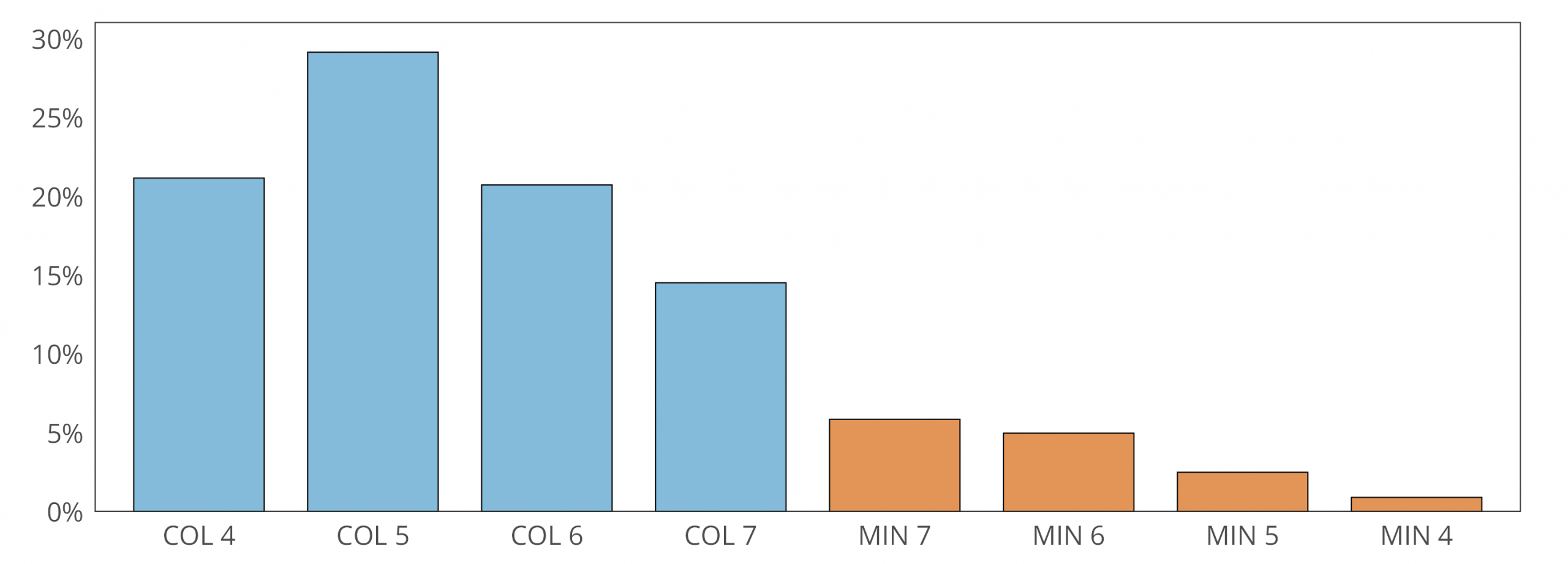
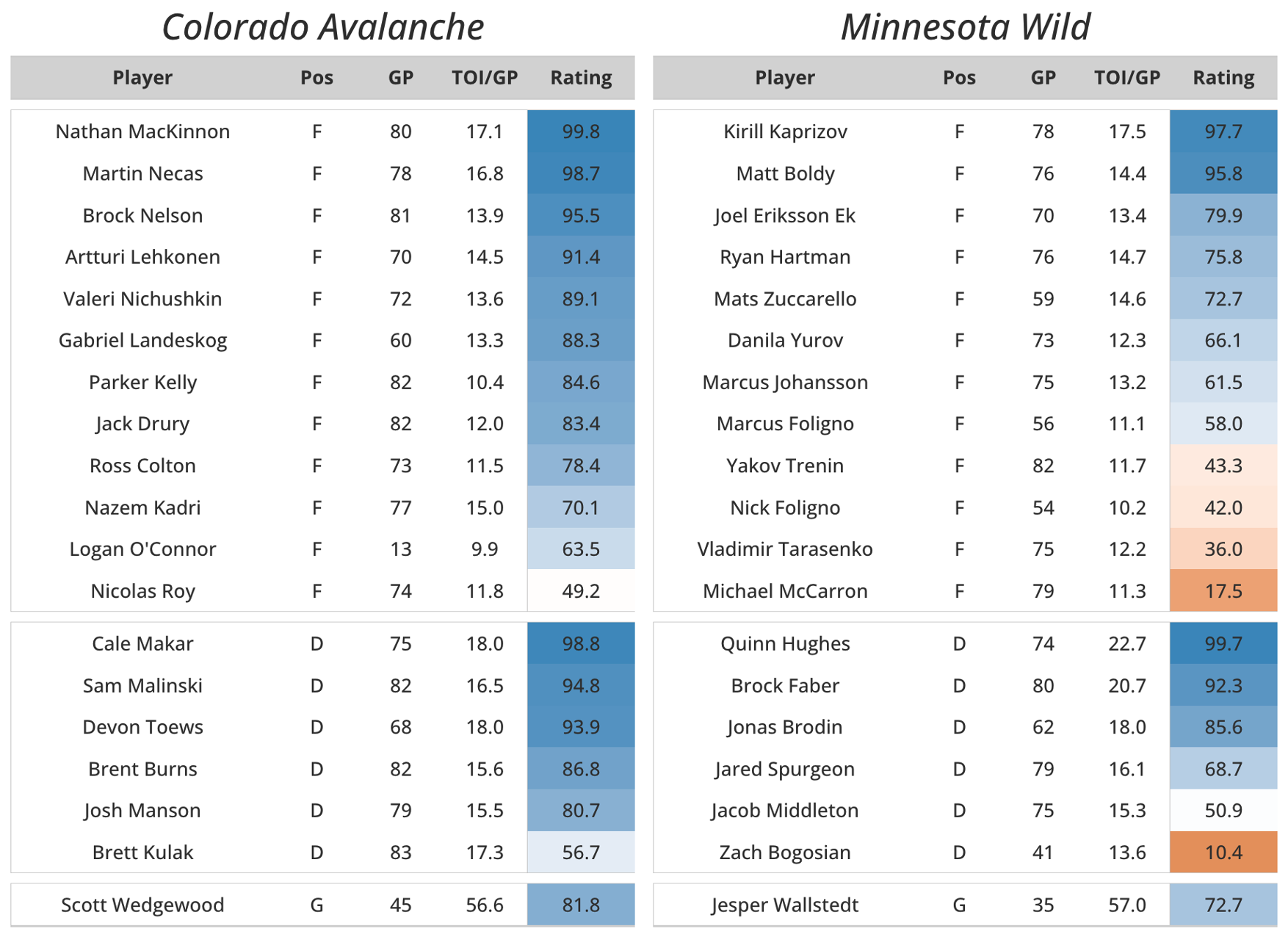
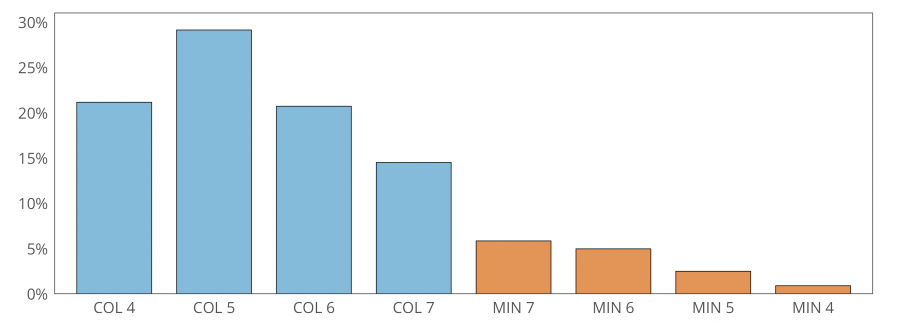
Colorado enters the second against a familiar foe in their longtime (but now somewhat forgotten) rival. There’s some history here, and one of their last meetings was possibly the most formative moment in my hockey fandom (Nino: ping). Funny enough, there’s a similar dynamic at play with team strength. The Kings made things a little interesting for the Avalanche in the first round, which is to say they only allowed four goals in the first two games and didn’t embarrass themselves during the next two. Through their four-game sweep, the Avs put up 68 more shot attempts than the Kings did at EV, finishing second in both CF% and xGF% in the first-round behind only PIT in the former and BUF in the latter. Like the Hurricanes, it feels a little silly to write, again, about how good this Avalanche team is. If there’s one weakness, even if it is as insignificant as a caffeine addiction, the Avalanche powerplay finished 24th in xGF/60 in the regular season, which will be a welcome relief for a Wild team that very well could have lost their first-round series playing shorthanded. That said, Colorado is insane. With only one player on their entire roster below average per our models, at least 4 defensemen that could play top-pair for the majority of the teams in the league, and the best tandem working right now (even if Wedgewood’s played every game so far), what else do you want me to say about this team? That they’re the Cup favorite? I said that last round. Unlike the Hurricanes, no one seems to be bored of the Avalanche, they just seem scared. Rightfully so. I mean, I’m scared. Like really scared.
The Minnesota Wild franchise has about three moments that they can really hold onto with pride, and the Avalanche factor into two of those: an Andrew Brunette goal and a Nino Neiderreiter goal. The third one is Jared Spurgeon. Luke and I were hoping for more from our projections here, and I find the output from the system that we made quite rude. While the Wild’s triumph over the Stars was impressive, Dallas had some issues. Don’t get me wrong, the Wild played quite well and still carry “contender” status among the general fan consensus. As I noted in the first round, the bottom-line(s) combination of McCarron, Tarasenko, N. Foligno, and Trenin and a shaky bottom-pair with one of Bogosian or Petry doesn’t grade well on paper. But McCarron and especially Trenin punched well above their expected statistical weight (maybe even actual), with Trenin finishing 6th in relTM CF±/60 and McCarron right in the middle among their regulars. While the rest of their depth struggled (or, rather, matched our expectations), this will be the major factor in the series. If the Wild can get valuable contributions from their 3rd and 4th lines, they could make things interesting. This is all without discussing Jesper Wallstedt’s incredible first round performance as a rookie. With the second highest GSAx at EV (7.7, behind only Andersen), Wallstedt enters the second-round riding high. Regardless, this is a lopsided series on paper, and I’m not happy about it. With injury concerns (Brodin, Eriksson Ek), and lineup decisions waiting (Yurov, Brink?), the Wild enter the second-round as heavy underdogs. I don’t care; I’m all in on this team. I’m ready to raise another “Beat Colorado in the Playoffs” banner. We’re good at doing that. It’s all we have.
Vegas Golden Knights (P1) vs. Anaheim Ducks (P3)
62.9% 37.1%
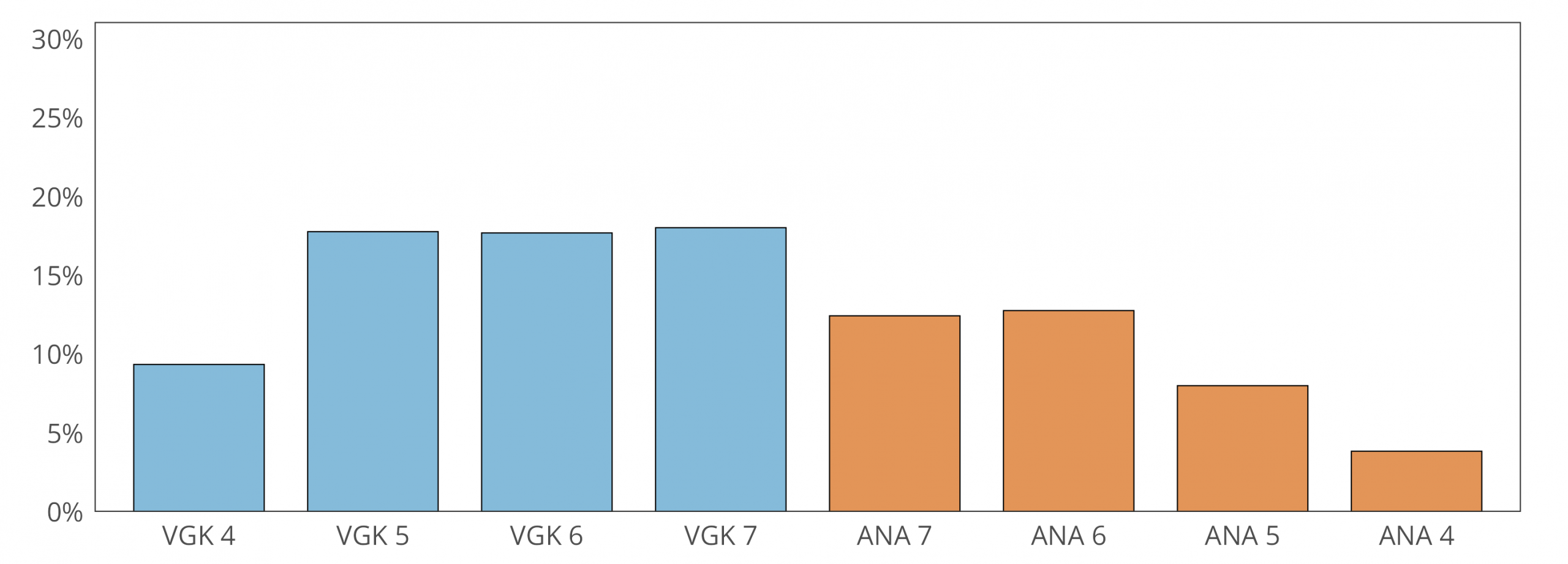
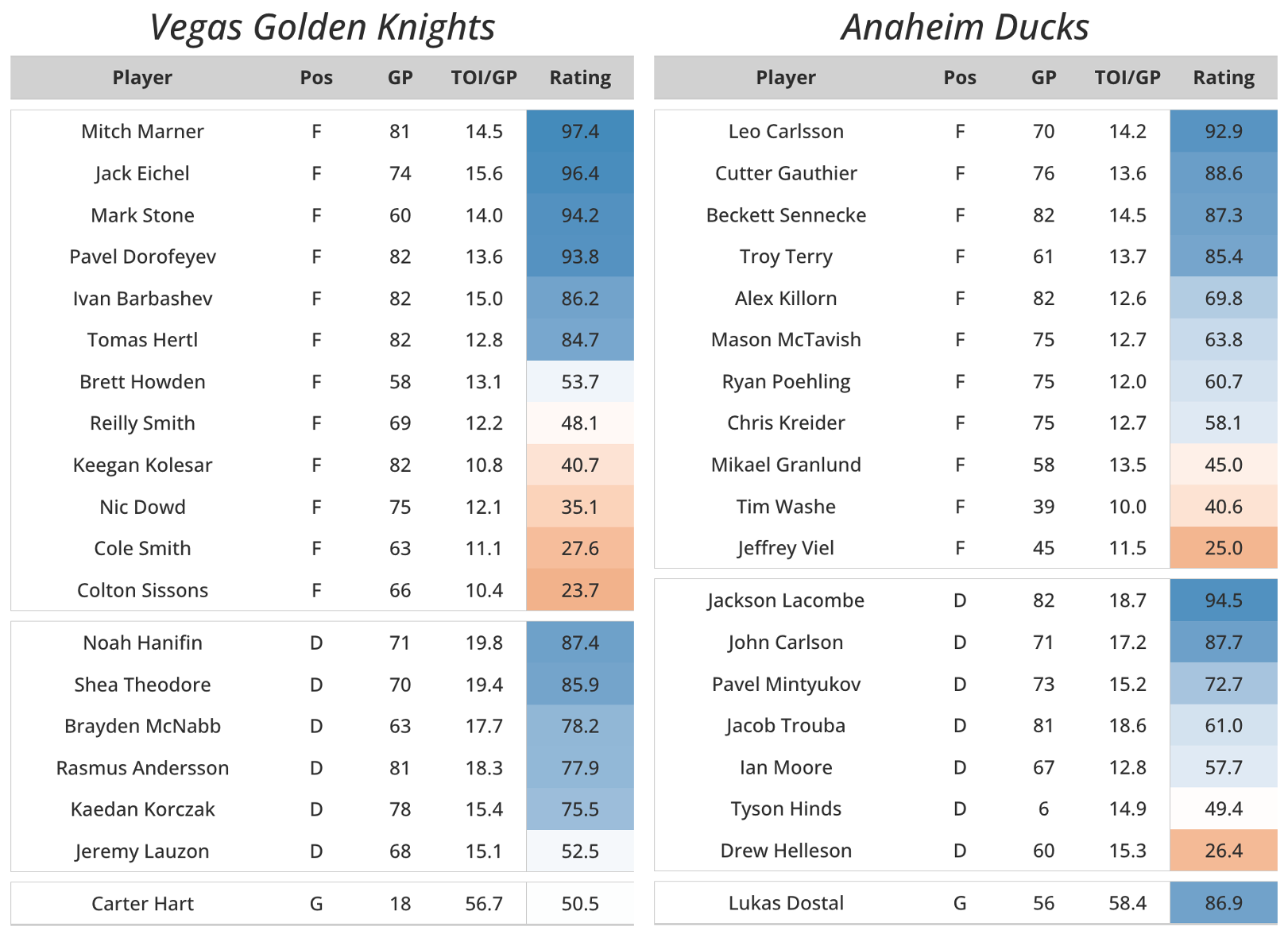
Vegas and Anaheim both finished their respective series in 6 games, each team put up almost identical Corsi For differentials at EV (+36 and +37), and both teams scored and allowed the same number of goals at EV (14 for and 17 against). It seems quite fitting they’re meeting here. The Knights are a flawed team with enough strengths to overshadow them, which includes an extremely robust group of defensemen and a top-6 forward group (even if Hertl slots in lower) that rivals the best. VGK / UTA was likely the least watched series among all eight in the first-round given its time slot and also it’s the Knights (maybe that’s just me, although I did watch quite a bit of it), but it felt like one of the closest series throughout even if it didn’t have the fireworks of DAL/MIN or TB/MTL. Possibly the biggest story for Vegas was Brett Howden: with 4 goals, he finished 2nd on the team and 17th in relTM CF±/60 among all skaters with more than 50 EV minutes (Mitch Marner was slightly above him). Besides their depth issues, Carter Hart continues to be questionable as Vegas’s #1. He finished with 0 GSAx through the entire series, above only three of the other starters in the first-round. Regardless, the Golden Knights enter the second round with a team two-thirds-full of real talent and legitimate experience; with no injury concerns (besides William Karlsson, out since March) and another time-slot out of the limelight, they’re the favorites.
Those crazy kids from Anaheim did the thing. A true David and Goliath matchup (not really at all), a team of 21-year-olds (not true in the slightest) defeated a group of legends in the first-round without issue (incredibly wrong). Ok, but you do have to hand it to the Ducks – they’re here and they’re fun. As I mentioned above, their series with the Oilers was quite close from the stats, even if the storyline understandably gravitates towards Edmonton’s future and not this scrappy team from somewhere in California that was not supposed to be here. The Ducks scored more goals in the first-round than any other team (both raw [26] and per-60 [4.3]). Sure, they also allowed the second-most goals per-60, but that doesn’t matter if you just win, right? Jackson Lacombe ended the first-round with one of the best performances from a defenseman: tied-2nd in points, top-20 in both relTM CF/xG differentials at EV, all while playing the 4th most minutes at EV (behind Hughes, Sanheim, and Faber). Chris Kreider, in a way, redeemed himself (I think he needs redeeming?) with top-10 relTM xG and G differentials. Anaheim’s biggest concern entering the second round (a trend?) is goaltending. Our goalie model likes Lukáš Dostál quite a bit, but his -3.3 GSAx was last among goalies in the first-round. While Vegas does not rely on shooting (26th in all-sit shooting percentage during the regular season, 15th in GF/60), and the Oilers’ shooting talent is well-known, Dostál needs to resemble our model and not his first-round performance. The similarities between the two teams will make this series interesting: questionable forward depth, untested/young goaltending, few injury issues, and high-end talent that can absolutely perform. The only real difference is the biggest gap in experience between the 8 teams left.