Would you look at that! Another annual exercise: trying to find players that we’d target at the deadline based entirely on multiple datasets with multiple objective parameters that can be fed into an R script… also known as an Evolving Hockey article. The trade deadline is in two days, so we’re a bit later here than we were last year, but surprisingly we haven’t missed much. The Olympic break may have something to do with that if GMs, like us, got obsessed with watching every winter sport you could 24/7 for two weeks straight and forgot to make the trades earlier. Or maybe not. Regardless, we’re hypothetically trading players before any other team, so that’s a win.
This is now our third year working through this process, and we’ve been quite happy with it. As a reminder for newcomers, we’re attempting to use the data at our disposal to whittle down the list of all currently active NHL players to those who are both 1) possibly available heading into the deadline and 2) good at hockey. While major news and media organizations often have more “inside” information about team and player situations, we have a more important thing: data. But in all seriousness, this is a fun and somewhat unique exercise in attempting to identify trade candidates based entirely on our data alone. At the very least, we feel the results are always interesting. Enough rambling, let’s whittle away.
The Process
The overall process looks like this (copied and altered from last year since I did such a good job explaining it then). We’re first targeting all players currently signed to a contract that will expire at the end of the ’25-26 season. This is our baseline. From this, we will remove several different groups of players who will likely be unavailable for acquisition over the next week or so. The following groups of players have been excluded:
- Any player that signed a contract extension since last summer
- Any player that has already been traded this season
- It’s possible we may see one of these players traded again, but for simplicity we are not including them here
- Any player with an expiring contract that didn’t play in either of the ’23-24 or ’24-25 seasons (this includes any player currently playing in their first NHL season)
- Any player currently playing on a team with a probability of making the playoffs above 50% per our team projections at the time of publication
For the players left after this filtering process, we calculate a weighted average (3/2/1) of every player’s prorated current season and prior two seasons metrics (points, GAR, xGAR), sort by the average of GAR and xGAR, and boom. That’s how we get our patented Evolving Hockey Big Board. A reminder and note: we’re not trying to identify the most likely trade targets, we’re trying to identify the best players that are potentially available. Ok, good. Let’s go.
The Big Board
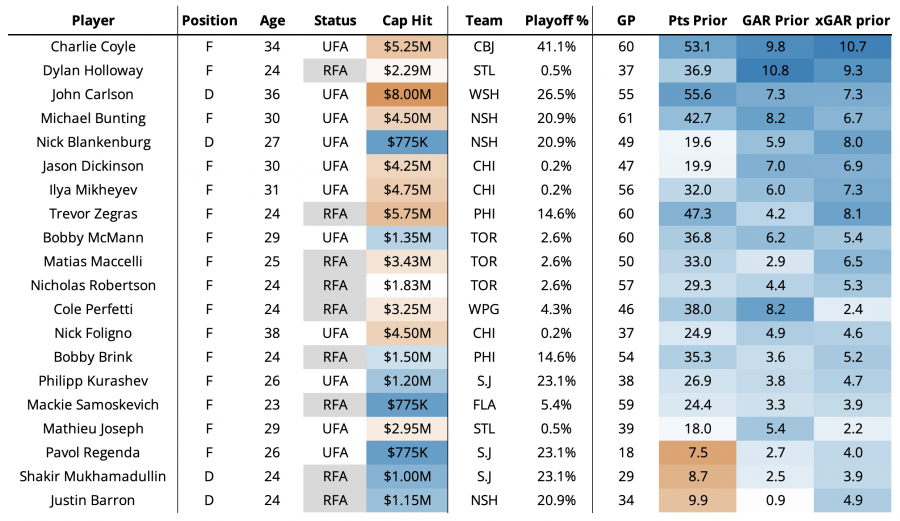
Like last year, we’re including both RFAs and UFAs in our search. UFAs are obvious to include, but it’s both interesting and potentially likely that a few RFAs see a move before Friday afternoon. Unlike last year, over half of the players here are actually UFAs, and several of the RFAs identified might make sense as potential deadline acquisitions. Even if there are extenuating circumstances surrounding the lack of an extension for these players, that they’re still unsigned by their current team and “good” is something to note regardless.
However, I think it’s fair to say that the available players this year are (at least using our method) a bit weaker than they were last year. We have no “star” names here (save John Carlson, who from all accounts seems unlikely to be traded), and most of the players that rank highly here aren’t the kind that might be described as major additions. That said, the GAR/xGAR values above aren’t that much lower than they’ve been the last two seasons; what’s more likely is that we’ve identified a group of players lacking in name recognition/reputation that still provide value at a comparable level to those from prior deadlines. I have a hunch it’s a bit of both, but my gut says this year is weaker than normal.
Possibly the most interesting aspect of this year’s deadline is the level of parity in the league and its impact on potential sellers. Given the volatility of the playoff race, especially in the East, it seems reasonable that multiple teams that historically would’ve been sellers may still feel they have a chance to make a run at a Wild Card spot (regardless of how ridiculous that chance may be). With quite a few teams within 5-6 points of a potential playoff spot and 20+ games to go, how many will admit they’re out of the race and make players available? Conversely, only two teams have been eliminated per our projections, and a handful have single-digit playoff probabilities. What is Chicago’s plan right now? Does Vancouver know they have six players signed until 2031? Does Toronto think they can still win games? (yes, they do). Nashville’s already admitted defeat? The trades these teams make (or lack thereof) will give us a lot of information about how they view their collective future in the next few years. Ok, player time.
Charlie Coyle
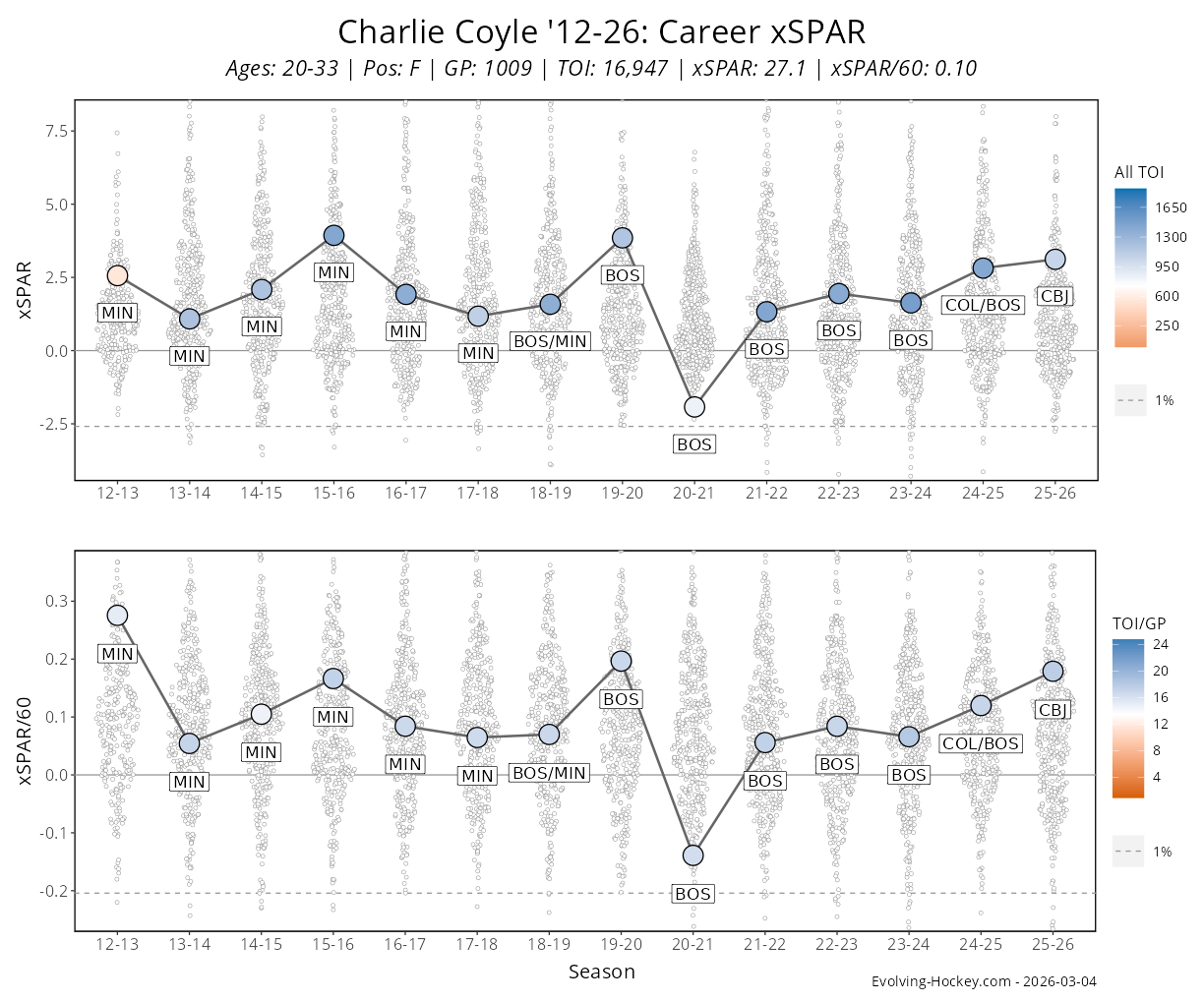
Ahh, Charlie Coyle, we meet again. The “average NHL forward” gold standard – except he’s actually pretty good now? We should say that Columbus is legitimately competing for a wild card spot (8-1-1 over their last 10 games with a win yesterday, playoff probability adjusted up to 51% as of a few hours ago). Regardless of whether Columbus considers trading him, he fits the criteria here and would be a great addition for any playoff bound team looking to bolster their forward depth. Coyle has always been a very solid forward, averaging around 6-10 xGAR every season throughout his 14 years in the NHL (we can ignore his -5.8 xGAR during the ’20-21 COVID season). Coyle’s spent the majority of his time with Mathieu Olivier and Cole Sillinger this year on Columbus’ 3rd line (2nd line?), and that’s likely where he’d fit on a contending team. Not much else to say – extremely consistent forward for a middle of the bag kind of player who kills penalties and could contribute on the second powerplay unit. He’s also a Minnesota Wild alum, which obviously adds a ton of value that teams will be definitely keep in mind.
Ilya Mikheyev
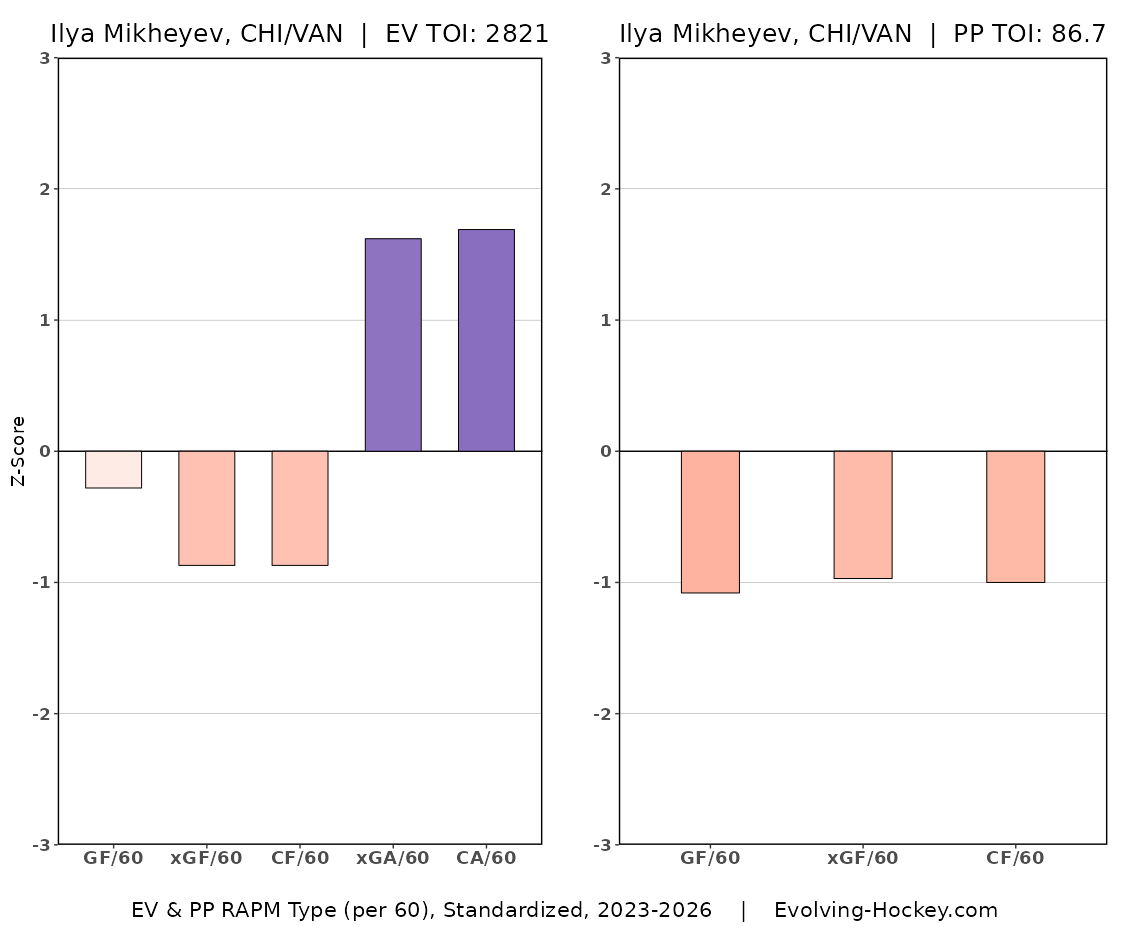
Mikheyev’s been pinging the Evolving Hockey radar (did I just make up a new metaphor?) since his last season in Toronto. Given his limited playing time there, his results were quite solid as a depth forward. While his tenure in Vancouver was shaky, his time in Chicago has been quietly stellar given the team he’s playing for. His 14.3 xGAR last season led all Blackhawks players, and while his even-strength defense has dropped off a bit this year, he’s still been quite good on the penalty kill. And this is without even talking about the ~11% career shooting percentage (because I would never talk about that positively). Mikheyev feels like a player Luke and I would’ve tweeted about (rest in peace) endlessly in 2019. There’s very little offense here, almost no powerplay value either, and he’s playing on the third line for one of the worst teams in the league. That right there is my kind of player. It wouldn’t surprise me at all if a strong team out West looking to bolster their penalty kill acquires him and accidentally creates a great third or fourth shutdown line. Colorado?
Cole Perfetti
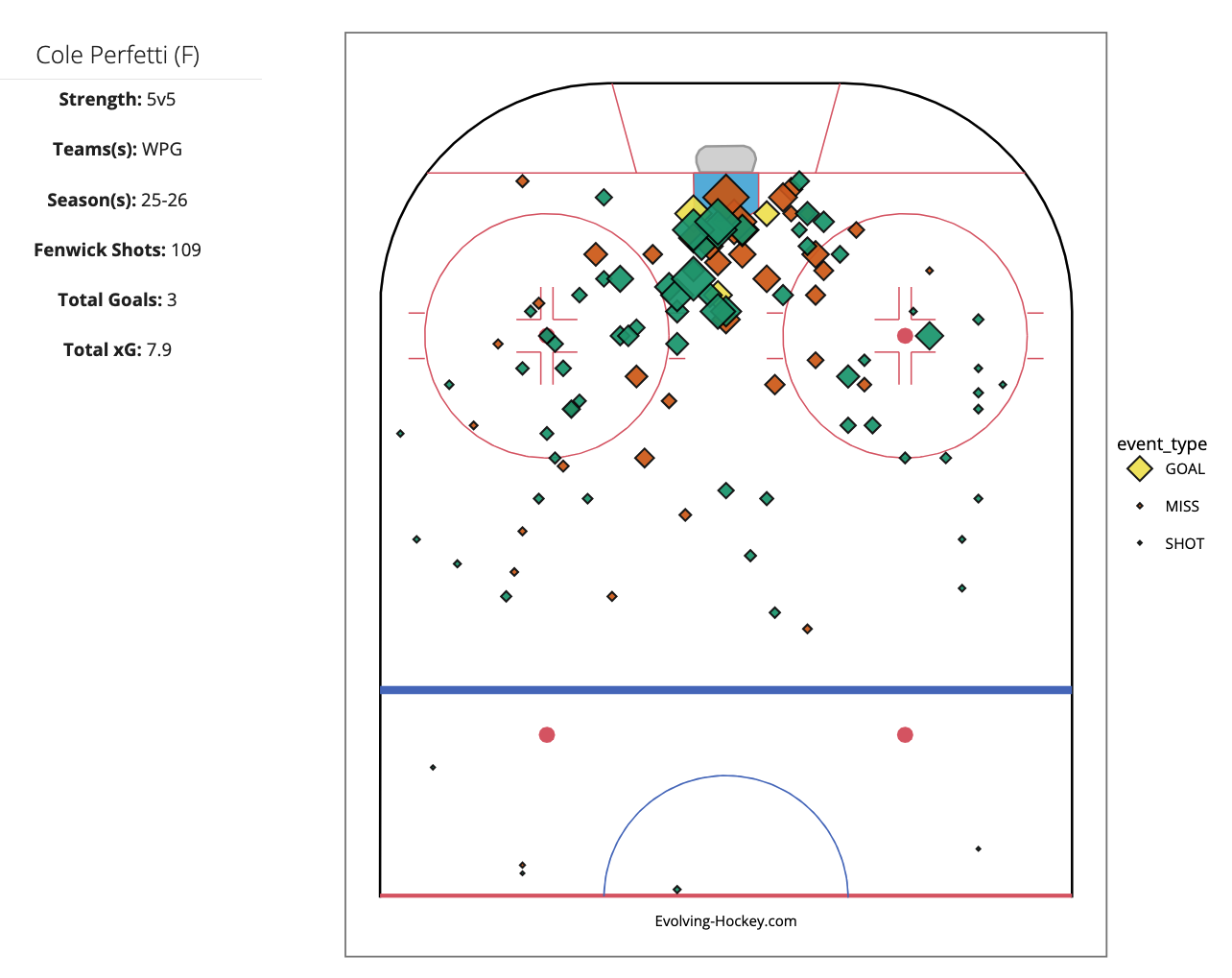
Normally a 10th overall 24-year-old RFA wouldn’t make this article because either A) he’d have already extended or B) it would be clear trading him wasn’t an option. However, with the Jets current place in the standings and Perfetti’s “disappointing” performance so far, a trade might be a real possibility. As one of the Jets’ top prospects for several years, the incredible offensive talent he displayed in juniors has not translated to the NHL. Through five seasons in Winnipeg, he’s never posted more than 5 xGAR in a single season, and his offensive ability has been mostly nonexistent per our metrics. Ironically, given how much his offense shaped his reputation as a prospect, Perfetti has been surprisingly good defensively. He currently leads the Jets in RAPM xGA/60 at EV this season, and 12.1 of his career 12.9 xGAR has come from even-strength defense. When I normally see this kind of profile for a highly touted early-20s prospect, I generally think that’s a player you go after if he’s available. A bridge deal with the Jets this summer seems much more likely than a trade right now, but Perfetti might be the most interesting potentially-available RFA heading into Friday.
Jason Dickinson
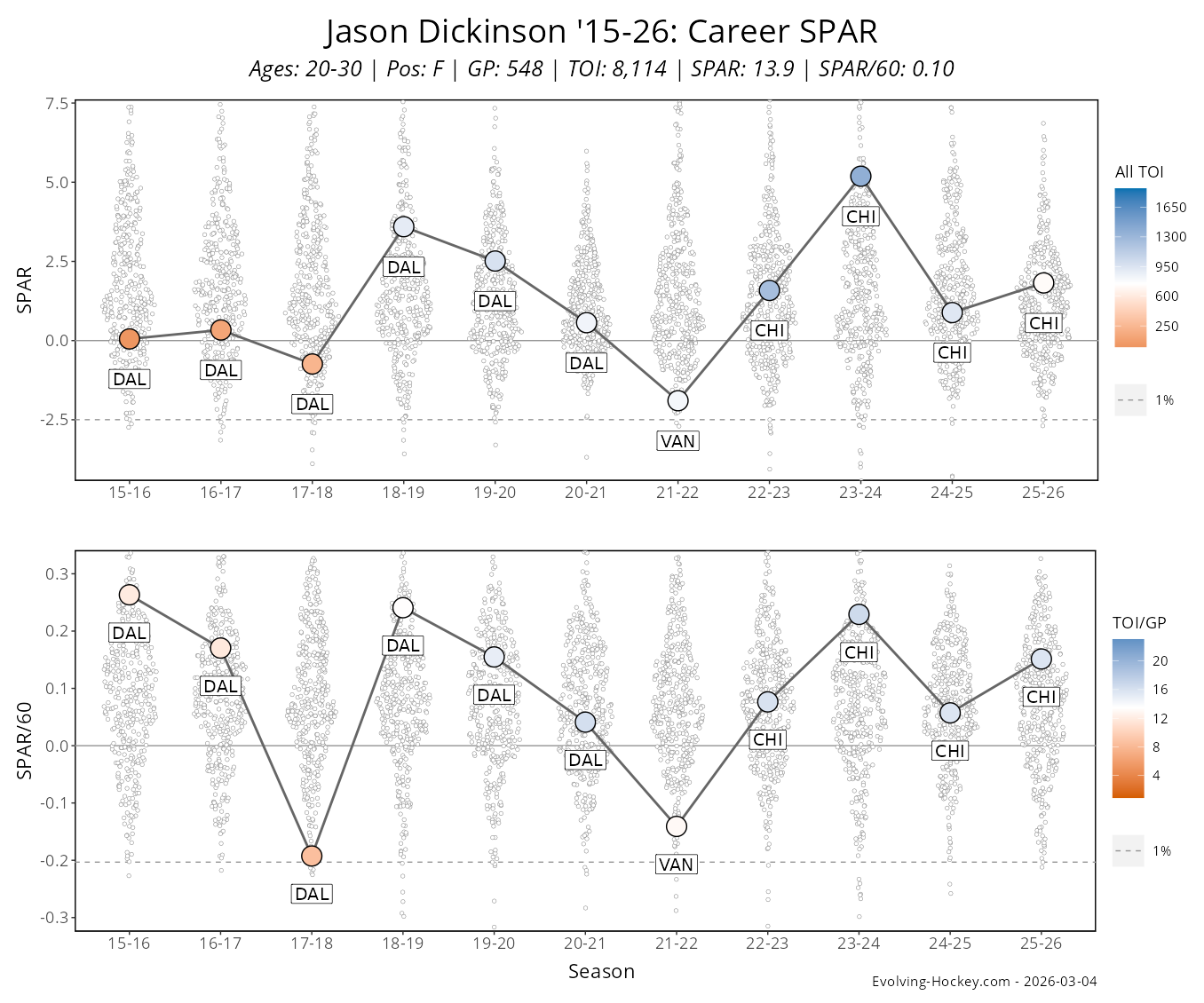
Of all the players on our big board here, few have defied the traditional career arc quite like Dickinson has. After emerging as a solid albeit young role player for Dallas, ahead of expansion the Stars traded him to Vancouver, where nothing really ever works out. Since then, Dickinson has either been the best player on his team (’23-24 Chicago), or one of the worst (’21-22 Vancouver, just behind Tyler Myers). It’s hard to really predict what you’re going to get from Dickinson at this point, but it’s clear that his ceiling is high. Something to note is that we’ve unintentionally identified and written about 2/3 of Chicago’s current third line as trade targets, which I’m not sure has ever happened here. Look, it seems plausible that a single team could trade for an entire line from another team if they thought it made sense. Does it? Probably not, but I’m just saying that that possibility exists if someone wants to be a hero. Just imagine the headlines.
Michael Bunting
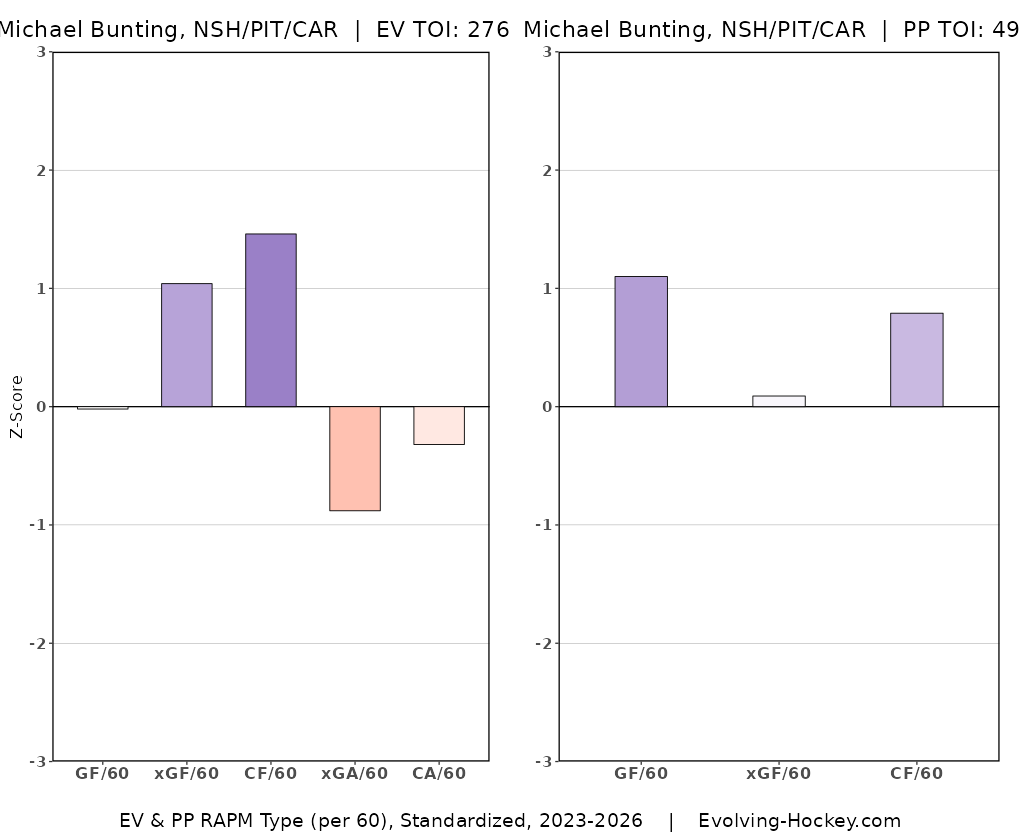
Our favorite Calder finalist from the 21-22 season, Michael Bunting is basically just Charlie Coyle (minus the penalty kill). He had a very strong 40-year-old rookie season in Toronto and has moved around quite a bit since then. I’m not sure what Nashville thinks they are right now, but they sit 5 points out of the second wildcard spot in the west and moving him seems like a reasonable thing for them to do at this point. Bunting, again, fits that forward depth role: nothing flashy, mostly offense, not great defensively but he doesn’t kill you there. Somewhat surprisingly, most of his value in our xGAR model comes from driving EV shot rates and quality (and not from shooting value). He’s shot ~12% his entire career (a reliable 20 goal scorer), but he’s had below average shooting value in that model for the past 4 years. If Evolving Hockey had a team, we’d probably go after Bunting just because Shawn would think it was funny.
Nick Blankenburg
I’m gonna be honest here, I really had no idea who this player was before he popped up on this year’s Big Board. Sure, I’ve seen the name before, but I never expected to be writing about him here. Given only 60 games over three seasons in Columbus and a 2nd/3rd-pair role with a very disappointing Nashville team this season, I think it might also make sense that you’re wondering what he’s doing here. The undrafted 27-year old depth defenseman has made any decision difficult for Nashville given his season this year (11 xGAR behind only Josi and Evangelista). While the team, technically, still has small chance of a playoff appearance with the state of the West being as it is, it seems clear they’re writing this season off as well. Nothing here is flashy, but again, for a contending team looking to fill a depth-defensemen role with some penalty-kill experience, Blankenburg might be that last piece they feel they need. That said, Nashville is an unfortunate mess right now, and it wouldn’t surprise me if they see Blankenburg as an important piece moving forward.
Bobby McMann
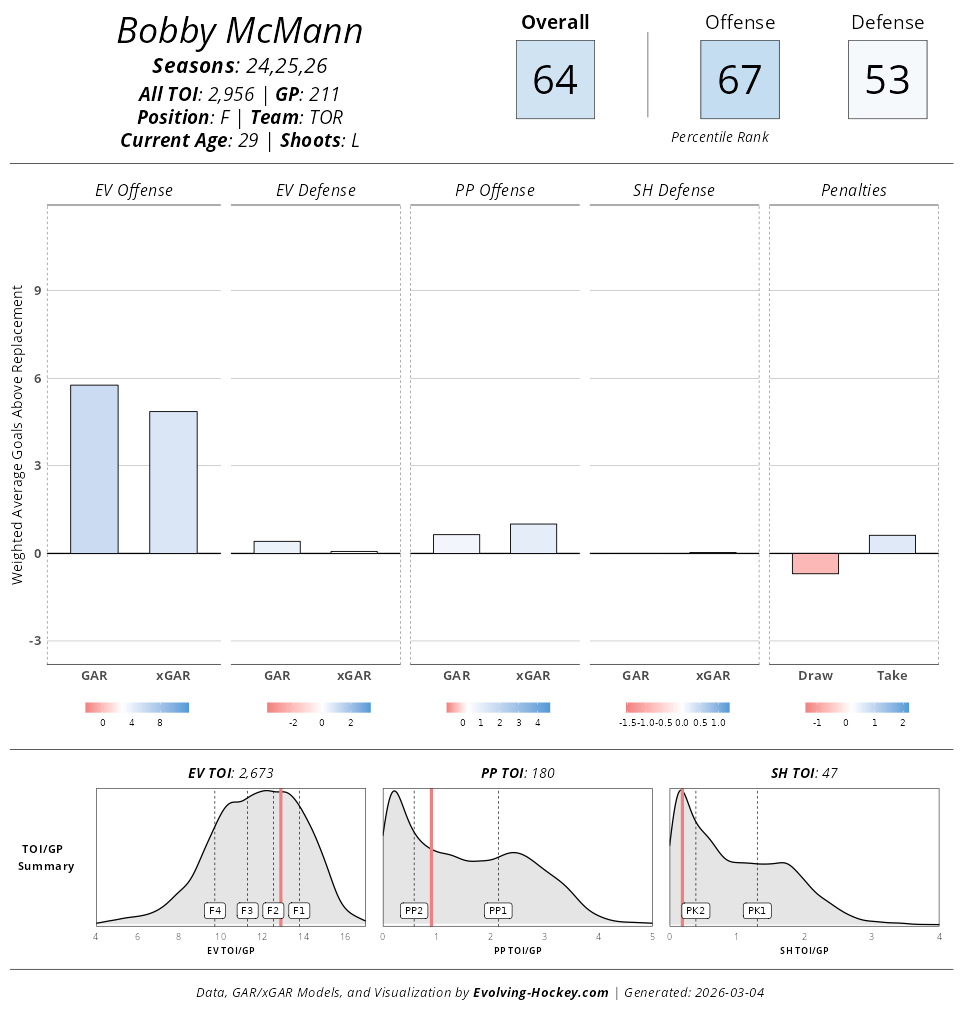
This undrafted 29-year-old accentuates the theme of this year’s deadline – there are a lot of solid depth forwards potentially available and not much else. I think Josh (who is my brother) has inadvertently developed a filtering process that finds the exact same pretty good player, and there happen to be a lot of them this year. The ‘25-26 Toronto Maple Leafs are exactly who we thought they’d be, and I’m not sure they realize just what they are (sort of like Nashville, but I think Nashville knows who they are). We’ll see if the Leafs are sellers at the deadline (they probably should be at this point). Regardless, McMann will likely be their best option if other teams have interest: a very similar player to Bunting who’s a slightly different version of Coyle – very solid offensively at even strength with pretty average results elsewhere (and little to offer on special teams). McMann’s spent 43.1% of his time at even strength with Auston Matthews and has moved around the lineup quite a bit. Even if the Leafs aren’t enthusiastic about selling, I think other teams should be; grabbing a player named Bobby McMann just to be able to have a hockey player named Bobby McMann on their team is something most contenders should heavily consider.